
Blog
The Fourth Trimester — What No One Tells You


The Fourth Trimester — What No One Tells You
Nobody warned me about the weeks after birth.
I had read every pregnancy book. I had a hospital bag packed at 34 weeks. I knew about contractions and epidurals and skin-to-skin contact. What I was not prepared for was coming home, sitting on the edge of my bed at 2am, baby finally asleep, and sobbing for no reason I could name.
Everyone tells you labour is hard. Nobody tells you that what comes after can be harder — quietly, invisibly harder.
The fourth trimester is the first twelve weeks after your baby is born. And for most new mothers in India, it’s a time that gets completely swallowed by the baby’s needs, family expectations, and the pressure to “bounce back.” Your recovery — physical, emotional, hormonal — barely gets a mention.
That ends here.
Your Body Just Did Something Enormous:-
Whether you delivered vaginally or by C-section, your body has been through significant trauma. That word sounds extreme, but it’s accurate. And yet, within days, there’s pressure to be up, functional, feeding, hosting visitors, and looking reasonably okay.
What’s actually happening to your body in these weeks:
- Your uterus is contracting back to its original size — those cramps after delivery are real and they hurt, especially during feeding. Dvija Kapol Powder is specifically made for post-delivery uterine cramps — an old Indian remedy, now properly formulated
- Your hormones drop sharply after delivery. Oestrogen and progesterone — which were at their highest ever during pregnancy — crash within 24 hours. That hormonal freefall is a direct cause of the weeping, the overwhelm, the feeling that you’ve made a terrible mistake
- Your core muscles, pelvic floor, and abdominal wall are essentially starting from scratch. Sitting up, laughing, coughing — all of it can feel different and sometimes painful
- If you had a C-section, you had major abdominal surgery. Six weeks is the minimum for basic healing. The scar needs care, movement needs to be gradual, and lifting anything heavier than your baby should wait
The Dvija Post Delivery Belt and Post Delivery Massage Oil are two things that genuinely help in this phase — the belt supports your abdomen as things settle back, the oil helps with circulation and the deep muscle soreness that doesn’t get talked about enough.
Breastfeeding Is Not Instinctive — And That’s Normal: –
This is one of the biggest myths of new motherhood. That it comes naturally. That your baby will “just know.”
Some do. Many don’t. And when it’s 3am, your nipples are cracked, the baby is screaming, and your mother-in-law is telling you your milk isn’t enough — it can spiral very quickly into guilt and formula guilt and the whole exhausting loop.
A few honest things about breastfeeding in the fourth trimester:
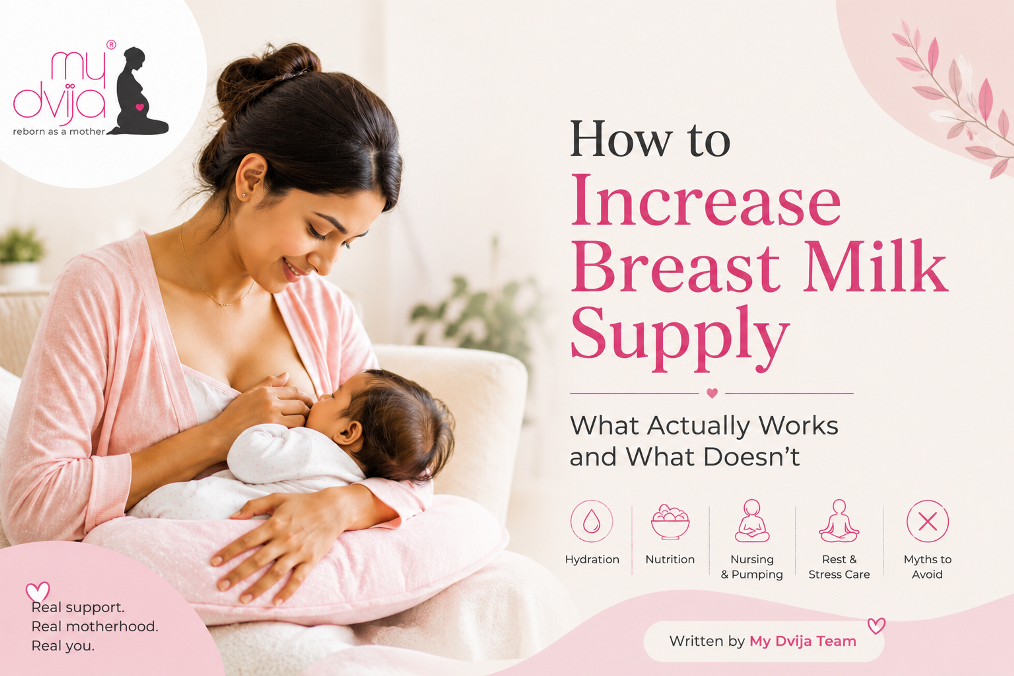
- Milk usually takes 3–5 days to come in properly. What you’re producing before that — colostrum — is small in quantity but incredibly concentrated in nutrition. The baby doesn’t need more
- The latch matters more than almost anything. A bad latch is the number one cause of nipple pain, low milk supply perception, and early weaning
- Supply is demand-driven. The more the baby feeds, the more your body produces. Supplementing early often reduces supply
If you’re struggling with milk supply, Dvija Breastmilk Booster is a homemade herbal blend that supports lactation naturally — no artificial anything. And if breastfeeding has become genuinely unmanageable, book a consultation with Shrreya Shah — she’s an internationally certified lactation consultant. This is exactly what she does.
There’s also a full free video on breastfeeding basics on the our YouTube channel- MyDvija if you need somewhere to start tonight.
The Emotional Side Nobody Prepares You For: –
Baby blues affect roughly 80% of new mothers. Crying for no reason, feeling detached, mood swings that seem disproportionate to what’s happening — this is normal for the first 2 weeks and it usually settles on its own.
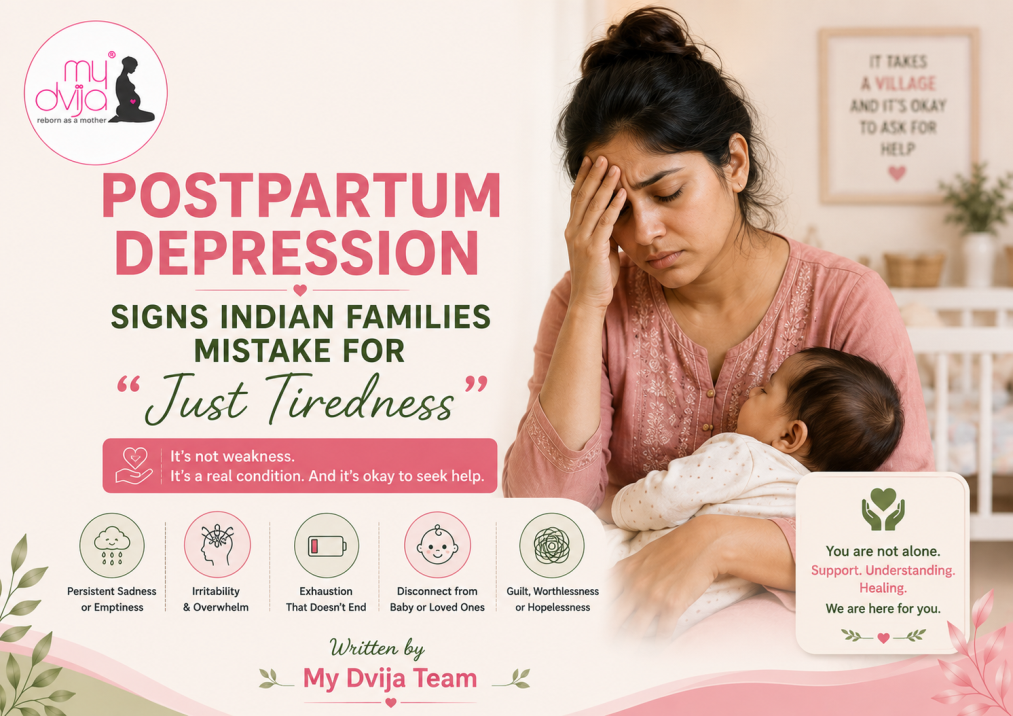
Postpartum depression is different. It’s more persistent, heavier, and sometimes comes with anxiety that doesn’t let you rest even when the baby is sleeping. It can appear any time in the first year — not just immediately after birth.
Signs to take seriously:
- Feeling like you’re not bonding with your baby, even weeks in
- Intrusive thoughts or irrational fears about something happening to the baby
- Complete inability to sleep even when you have the chance
- A persistent feeling that something is wrong with you, or that you’ve made a mistake
If any of this sounds familiar — please say it out loud to someone. Your doctor, your husband, Shrreya. The stigma around postpartum mental health in India means too many women suffer through it silently for months. You don’t have to.
What About Your Hair and Skin? :-
Around 3–4 months postpartum, a lot of women start noticing alarming amounts of hair in the shower drain. This is called postpartum hair loss — technically, telogen effluvium — and it happens because during pregnancy, high oestrogen kept hair in the growth phase longer than usual. After delivery, it all starts shedding at once.
It almost always stops on its own by 6–9 months. But if you want to support your hair through it, Dvija Kesh Powder and Dvija Mothers Hair Fall Oil are formulated specifically for this phase.
Stretch marks and pigmentation are also common conversations nobody quite prepares you for. Dvija Mom’s Ubtan works on both — it’s the same ubtan philosophy your nani probably used, properly made and safe for new mums.
The Joint Family Question :-
For many Indian women, the fourth trimester happens inside a joint family. And that can be a blessing — help with the baby, food being made, someone to hold the baby when you need five minutes. But it can also mean zero privacy, conflicting advice coming from every direction, and feeling like your own recovery is the last item on everyone’s list including your own.
A few things worth saying directly:
- You are allowed to rest. Even with a joint family. Even if they think you should be up and about already
- Your husband needs to actively create space for your recovery — not just “support” in theory but in practice, meaning he handles the in-laws when needed
- The traditional 40-day rest period (jaapa) exists for a reason. Modern life makes it hard, but the principle — that new mothers need deliberate rest — is not old-fashioned. It’s medically sound
MyDvija’s Care Club for Mom & Baby covers exactly this phase — from 3 months postpartum right through to your baby’s second birthday. It’s the closest thing to having someone walk alongside you through all of it.
Also Worth Reading :-
- Postpartum Weight Loss: Real Talk for Indian Moms
- Sleep Training Without Crying It Out: Gentle Methods That Actually Work
- How to Stop Breastfeeding Without Breaking Your Heart (Or Your Child’s)
- Explore all blogs →
The fourth trimester is one of the most significant transitions a woman goes through. It deserves the same attention, preparation, and support that pregnancy gets.
You grew a human. You delivered them. You’re keeping them alive on broken sleep and sheer willpower. That’s not a small thing. Take care of yourself with the same seriousness you take care of your baby. They need you well — not just present.
Browse MyDvija’s full Mother Care range — everything there was made by mothers, for mothers, with exactly this phase in mind.