

Blog
Ragi for Babies — When to Start, How to Make, and Why It Belongs in Every Indian Baby’s Diet

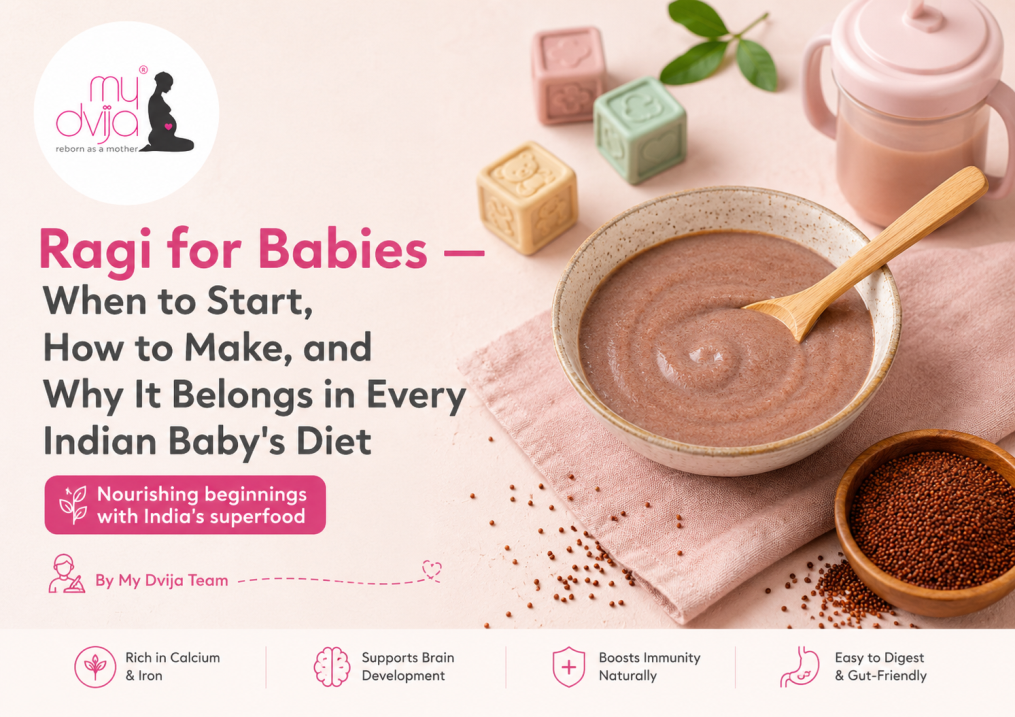
Ragi for Babies — When to Start, How to Make, and Why It Belongs in Every Indian Baby’s Diet
When I started my son on solids, my paediatrician said “start with rice cereal.” My mother said “start with ragi.” My mother-in-law said “ragi is too heavy, wait till 8 months.”
Three completely different instructions in one afternoon.
Ragi — also called finger millet, nachani, or mandua depending on which part of India you’re from — has been fed to babies across the subcontinent for centuries. And yet somehow, in the age of packaged baby food and paediatrician advice that often leans Western, it’s been sidelined. Many urban Indian parents aren’t even sure if it’s safe for babies, when to start, or how to prepare it properly.
It’s not only safe. For most Indian babies, it’s one of the best first foods you can offer. Here’s everything you actually need to know.
What Is Ragi and Why Is It So Good for Babies? :-
Ragi (Eleusine coracana) is a whole grain — a tiny, dark seed that has been cultivated in India and Africa for thousands of years. Unlike most grains, it’s eaten whole — the grain is simply dried and ground, so nothing is removed and nothing is lost in processing.
Why it’s exceptional for babies specifically:
- Calcium: Ragi has the highest calcium content of any grain — higher than milk on a per-gram basis. For babies transitioning to solids who are also reducing breastmilk intake, this is significant. Calcium is foundational for bone development, teeth, and nerve function
- Iron: Iron deficiency is one of the most common nutritional problems in Indian infants after 6 months, when the iron stores from birth begin to deplete and breastmilk alone can no longer meet the demand. Ragi provides non-haem iron in meaningful amounts
- Dietary fibre: supports gut health and healthy bowel movements — constipation is a common issue when babies start solids, and ragi’s fibre content helps significantly
- Amino acids: particularly methionine and tryptophan, which are important for brain development and are found in lower amounts in other commonly fed grains like rice
- Easy digestibility: despite being a whole grain, properly prepared ragi is gentle on a baby’s developing digestive system — more so than wheat, and comparable to rice when cooked well
- Gluten-free: suitable for babies with gluten sensitivity, making it a safe first grain for almost all babies
There is a reason Indian grandmother have been making ragi porridge for babies for generations. It wasn’t tradition for the sake of tradition — it was nutrition that worked.
When to Start Ragi for Babies: –
Ragi can be introduced from 6 months — as soon as your baby shows the readiness signs for solids (sitting with support, tongue-thrust reflex fading, interest in food). It is an appropriate first food and does not need to be delayed until 7 or 8 months as some older advice suggests.
The concern about ragi being “too heavy” is not nutritionally founded. What it likely refers to is the consistency — a poorly made ragi porridge that’s too thick or lumpy is hard for a 6-month-old to manage. The preparation matters, not the grain itself.
One note: in very rare cases, ragi can cause constipation in some babies, particularly if introduced in large quantities at once. Start with 1–2 teaspoons of prepared porridge, observe for 2–3 days, and increase gradually. If constipation occurs, reduce the amount and increase water intake.
Sprouted vs. Unsprouted Ragi — Does It Matter? :-
This is the part most blogs skip over and it’s actually the most important part.
Raw ragi contains phytic acid — a naturally occurring compound in grains and legumes that binds to minerals like iron, calcium, and zinc and reduces how much your baby can actually absorb. You can put all that calcium and iron into a baby’s body but if phytic acid is binding it, very little of it reaches the bloodstream.
Sprouting breaks down phytic acid dramatically. When a grain sprouts, its own enzymes activate and neutralise the phytates. The result: significantly better mineral bioavailability from the same grain. Studies consistently show that sprouted ragi delivers substantially more absorbable iron and calcium than unsprouted ragi — sometimes double or more.
Sprouting also:
- Increases the digestibility of the grain — the complex starches begin to break down, making it easier for a baby’s immature gut to process
- Reduces cooking time — sprouted and dried ragi cooks faster and smoother
- Slightly increases the protein content and improves the amino acid profile
This is why — if you’re going to feed ragi to your baby, feeding sprouted ragi is meaningfully better than unsprouted. The nutritional difference is real.
How to Sprout and Prepare Ragi at Home: –
This is the traditional method and it works well, though it takes planning:
To sprout: –
- Wash the ragi grains thoroughly and soak in water for 8–12 hours
- Drain, spread on a damp cloth, and cover loosely. Leave at room temperature for 1–2 days, rinsing once a day, until small white sprout tips appear
- Once sprouted, dry completely in the sun or in a low-temperature oven (50–60°C) until fully dry and crisp — 6–8 hours
- Grind to a fine powder and store in an airtight container for up to a month
To make porridge: –
- Mix 1–2 teaspoons of sprouted ragi powder with a little cold water to form a lump-free paste
- Add this paste to ½ cup of warm water or diluted cow’s milk (after 12 months) or breastmilk and cook on low heat, stirring constantly, for 5–7 minutes until it thickens
- For babies 6–8 months: keep it thin — almost a liquid consistency
- For babies 8–12 months: slightly thicker, still smooth
- Natural sweetener: a pinch of Dvija Natural Jaggery Powder or a few drops of Dvija Dates Syrup — both iron-rich alternatives to refined sugar, and both traditional additions to ragi porridge across India
The Easier Route — Sprouted Ragi Already Done for You: –
The sprouting and drying process is entirely doable but requires 2–3 days of advance planning. For days when you haven’t sprouted a batch, or when you’re just starting out and want to make sure, you’re getting it right, MyDvija’s Nachani Satva (Sprouted Ragi) removes all of that work.
It’s already sprouted, already dried, already ground fine — by mothers, for mothers, with no additives, no preservatives, no maltodextrin, no refined sugar. Just sprouted ragi, ready to cook.
The difference between this and commercial ragi baby cereals in a tin: those are typically made from unsprouted ragi processed at high heat (which degrades nutrients), then “fortified” with synthetic iron and calcium to compensate for what the processing removed. You’re paying for the box and the marketing. MyDvija’s Nachani Satva skips all of that — it’s the grain, properly prepared, nothing else.
Cook it exactly as above: paste in cold water first, then cook with warm liquid for 5–7 minutes. Done in under 10 minutes from start to bowl.
Ragi Recipes by Age: –
6–8 months — Plain Ragi Porridge: –
Sprouted ragi powder cooked thin with water, cooled, fed with a spoon. No salt, no sugar. Let your baby taste the grain. The slightly earthy, slightly nutty flavour is distinct from rice and it’s worth letting them adjust to it without masking it with sweetness immediately.
8–10 months — Ragi with Banana: –
Cook the ragi porridge slightly thicker. Once cooled, mash in a small piece of ripe banana. The banana sweetens naturally, adds potassium, and the texture change is good practice for the developing palate. One of the most universally accepted combinations at this age.
8–10 months — Ragi with Cow’s Ghee: –
A teaspoon of Dvija Cow Ghee (Vedic Style) stirred into cooked ragi porridge. Ghee significantly improves the absorption of fat-soluble vitamins, adds calories (important for growing babies), and makes the porridge more palatable. This is the traditional preparation across Maharashtra, Karnataka, and Tamil Nadu — it exists for good reason.
10–12 months — Ragi Kheer: –
Cook sprouted ragi with diluted full-fat cow’s milk (once introduced, typically around 10–12 months as a food — not as the main drink before 12 months), a pinch of cardamom powder, and jaggery powder to taste. This is a complete meal — grain, dairy, fat, and natural sweetener. Many Indian babies eat this well into toddlerhood and it’s nutritionally excellent at every stage.
10–12 months — Ragi Dosa or Ragi Idli: –
For babies eating table food with the family, ragi flour blended into dosa batter or idli batter adds nutritional density without changing the texture significantly. Soft ragi dosa pieces are excellent finger food and the fermentation process in the batter further reduces phytic acid content — making it even more nutritious than plain cooked ragi porridge.
What About Ragi Biscuits and Commercial Ragi Products? :-
A quick note on this because many parents assume any product with “ragi” on the label is automatically healthy.
Most commercial ragi biscuits and ragi baby snacks contain refined wheat flour as the first ingredient (ragi is often third or fourth), with added sugar, palm oil, and various additives. The ragi content is sometimes token — enough to put it on the front of the packet, not enough to deliver the nutritional benefits you’re expecting. Always read the full ingredients list, not the front of the box.
For a genuinely ragi-based snack, MyDvija’s Wheat Teething Baked Sticks are baked from whole wheat with jaggery, ghee, ajwain, and jeera — no refined flour, no synthetic sugar. Not ragi-based, but a reliable whole-food snack for the same age group when you want something the baby can hold and chew.
Starting Solids and Not Sure Where to Begin? :-
If your baby is approaching 6 months and you’re unsure about the full picture — what to give first, what order, whether to do purees or finger foods, how to introduce allergens, and what to definitely avoid — MyDvija’s free orientation session for Weaning & BLW covers all of it in one session. Free, structured, and designed for Indian families. The most useful hour you’ll spend before the first bowl of ragi.
Shrreya Shah covers first foods, weaning approaches, and baby nutrition in detail on our MyDvija YouTube channel — browse the baby nutrition playlist for free guidance in Hindi.
Also Worth Reading: –
- The Truth About Packaged Baby Food (And What to Use Instead)
- Signs Your Baby Is Ready for Solids — Beyond the 6-Month Rule
- Baby Food Chart 6 to 12 Months Indian
- Starting Solids: A Real Guide for Confused Indian Moms
- Subscribe to the MyDvija YouTube channel →
- Explore all blogs →
Ragi doesn’t need rebranding or a new marketing story. It just needs to be prepared properly and given the place in your baby’s diet that it’s always deserved.
Your grandmother knew this. Your mother probably knew this. And now, with the sprouting science to back it up, you know exactly why they were right — and exactly how to do it.