
Blog
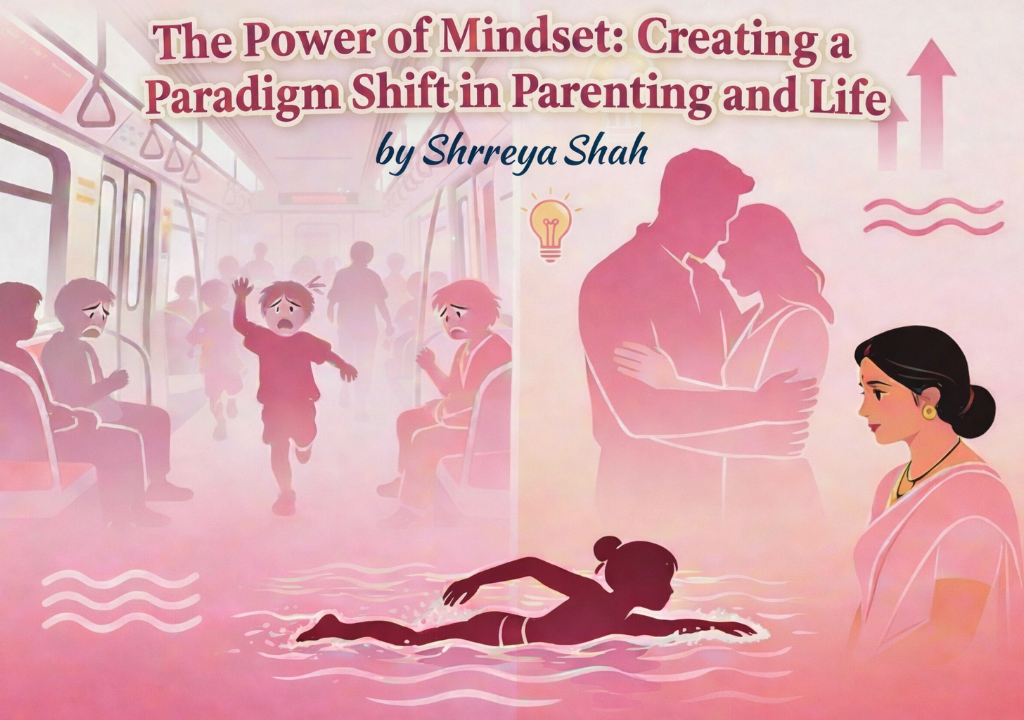
The Power of Mindset: Creating a Paradigm Shift in Parenting and Life

The Power of Mindset: Creating a Paradigm Shift in Parenting and Life
As I meet so many mothers and couples who come to me for counselling—whether it is related to parenting, children’s diet, or managing day-to-day behaviour—I often find myself reflecting deeply on my own life and the people around me.
This blog is a reflection of my inner questioning.
It is my journey toward understanding the “why” behind my thoughts, reactions, and assumptions—and toward getting my paradigm right.
What Is a Paradigm?
A paradigm is a mental framework that contains our basic assumptions about life, people, and situations.
This made me pause and ask myself:
- Do I make assumptions on a day-to-day basis?
- Do these presumptions affect my results and my life?
While looking for answers, my friend Rupak told me a moving story that was first told by Stephen Covey, the author of The 7 Habits of Highly Effective People.
Stephen Covey’s Subway Experience: A Story That Transformed Everything: –
A personal story from a Sunday morning subway ride in New York was originally told by Stephen Covey.
Some were reading newspapers, some were deep in contemplation, and still others were dozing off with their eyes closed. It was serene and quiet. Unexpectedly, a father and his children walked into the subway.
The kids were rowdy, noisy, and restless. They were yelling, hurling objects, and even snatching papers from others. The man sat next to Covey and closed his eyes, seemingly unaware of the chaos. Irritation grew—not just in Covey, but among everyone in the subway car.
Finally, with what he felt was unusual patience, Covey said to the man,
“Sir, your children are really disturbing a lot of people. I wonder if you couldn’t control them a little more.”
The man slowly lifted his gaze and said softly,
“Oh, you’re right. I guess I should do something about it. We just came from the hospital where their mother died about an hour ago. I don’t know what to think, and I guess they don’t know how to handle it either.”
When the Paradigm Shifts: –
In that moment, everything changed.
Covey’s irritation vanished. He didn’t have to force himself to change his behaviour—his heart changed naturally. Compassion replaced judgment. Empathy replaced irritation.
He later wrote that his paradigm shifted instantly.
When the way he saw the situation changed, his feelings and actions followed effortlessly.
How Quickly We Judge: –
This story made me realise how natural it is for us to carry pre-assumptions about:
- People around us
- Our children
- Friends
- Our spouse
- Even ourselves
We often approach situations and conversations with a pre-written script in our minds. Because of this, we sometimes miss the reality behind the behaviour.
My Own Assumptions: A Personal Reflection: –
I have always loved swimming, but I never learned it consistently. Somewhere deep within me lived an assumption:
“I won’t be able to do it.”
With this belief, every attempt failed.
In contrast, I began observing my elder daughter, who swims 5–6 days a week.
What I Learned from My Daughter’s Mindset: –
Monday:
“Mumma, my friend punched me in my tummy today, so I can’t swim.”
👉 She still swam 250 meters.
Tuesday:
“Mumma, today I am very excited—I will do my longest swim.”
👉 She swam 550 meters for the first time.
Wednesday:
“Mumma, I have a small scratch. It hurts in water, but I will try.”
👉 She swam 300 meters with tears and excuses.
Thursday:
Coach said, “Let’s go for long-distance swimming.”
👉 She surprised everyone with 1200 meters nonstop.
Friday:
“Mumma, let’s go quickly. I have a movie after swimming.”
👉 Fastest warm-up, no excuses, full swim.
Saturday:
“Mumma, today are time trials. I want my best timing.”
👉 She gave her best 50-meter backstroke timing.
What This Taught Me About Mindset: –
The mindset with which she began the activity determined the outcome.
I realised:
- The energy to execute a task is generated by the way we think
- When I begin with assumptions, I unknowingly decide the result in advance
So yes—it truly is a mind game.
The end always begins in the mind.
Changing Perception Changes Fear: –
I recalled my own childhood fear of darkness. I couldn’t even go to the washroom alone if there was no electricity. As I grew older, the fear reduced—but what truly changed everything was my perception.
I started seeing beauty in darkness—nature, silence, calm.
Today, I can stand alone for hours without light, without fear.
Everyday Examples of Assumptions: –
- When my father-in-law warns my younger daughter repeatedly while climbing stairs, she often stumbles—almost fulfilling the expectation.
- When my maid looks disturbed, I assume her work will be poor—and eventually find faults.
- When a gossip-loving friend calls, I anticipate gossip and unconsciously avoid the call.
How powerful assumptions are!
What Shapes Our Mindset?
Through observation, I realised our mindset depends on a few key factors:
- Liking or Disliking
If my daughter Siya is asked to help in the kitchen, suddenly her legs hurt. But if a friend calls her to play, all tiredness disappears.
- Motivation or Push
A late-night movie of my favourite actor?
Easy. A distant relative’s wedding at the same time? Requires great effort.
- Clarity of Direction
A friend of mine, Isha, is extremely consistent with her daughter’s sports routine. When I asked her why, she said:
“I see my reflection in her. I know how proud and happy she feels at the end of the day—and that tells me I am doing justice to my role as a mother.”
- Prejudice
Past experiences often colour present perceptions—even when situations change.
- Fairness and Neutrality
Can I remain neutral and positive toward myself and others?
A Final Realisation: –
After my 12th standard exams, I believed I wouldn’t clear my entrance test.
That belief became my reality.
“The right mindset at the beginning is the first step toward success.”
Choosing Conscious Assumptions: –
I realised I have two choices:
- Change assumptions based on situations
- Or train my mind to carry positive thinking consistently
Action must follow belief.
My Commitment Going Forward: –
I will be conscious of my assumptions:
- In the way I begin my day.
- In the way I parent my children.
- In the way I express love in my marriage.
- In the way I relate to people.
- In the way I honour my professional commitments.
Small changes can create big differences…
I will start each day with a belief my teacher once instilled in me:
“Today, I will think a little better than yesterday—in all my roles.”
Let us create a paradigm shift—
by understanding ourselves and others more positively
before playing the movie in our minds.
Courses & Video that will help you: –
- Post Delivery Emotional Management (Free Recorded Course)
Helps parents understand and manage emotions with practical coping strategies after childbirth—very relevant to emotional paradigm shifts.
https://mydvija.com/product/post-delivery-emotional-management-english/
- Strength Exercises + Diet + Emotional Management – New Mother
Supports emotional resilience, balanced health, and mental well-being alongside physical recovery.
https://mydvija.com/product/strength-exercises-new-mother-english/
- Free Orientation – Weaning & BLW (Peaceful Solid Food Introduction)
Though focused on feeding, it includes mindful parenting and positive behavioural approaches toward food and growth.
https://mydvija.com/product/free-orientation-weaning-and-blw-peaceful-solid-food-introduction/
Live Online Courses (Parenting & Behaviour Focus)
These help parents understand children holistically, which ties to how assumptions and mindset shape responses.
- Toddler Ko Khana Kaise Khilaye? (1yr–5yr) – Nutrition and mindful parenting.
👉 https://mydvija.com/product/toddler-fussy-eater/
- Advance Gurukul – A Step to Make Child Life Ready (3yr–7yr) – Builds consistency, routines, and confident parenting.
👉 https://mydvija.com/product/advance-gurukul-insightful-parenting-with-fun-3yr-9yr/
- Early Gurukul – First Learning Ground of Child’s Life (6mo–3yr) – Helps parents tune into emotional, cognitive, and behavioural growth stages.
👉 https://mydvija.com/product/early-gurukul-full-course/
Recommended Videos
These videos support the mindset, emotional regulation, and conscious parenting themes in your blog.
Emotional & Parenting Focus
- 8 Facts for Emotional Wellbeing of a Mother – Helps parents understand and manage emotions better in daily life.
https://www.youtube.com/watch?v=tcqe1OPE5RA&pp=ygVA4oCiCTggRmFjdHMgZm9yIEVtb3Rpb25hbCBXZWxsYmVpbmcgb2YgYSBNb3RoZXIgIGJ5IFNocnJleWEgU2hhaA%3D%3D
- Play Dates with Parents & Child Psychology – Builds connection and understanding of child behaviour with calm responses.
https://www.youtube.com/watch?v=ZQ-0PEMfwWw&pp=ygU04oCiCVBsYXkgRGF0ZXMgd2l0aCBQYXJlbnRzICYgQ2hpbGQgIGJ5IFNocnJleWEgU2hhaNIHCQlNCgGHKiGM7w%3D%3D
Takeaway Message: –
Change your lens.
Change your assumptions.
And watch how life responds differently.