
Blog
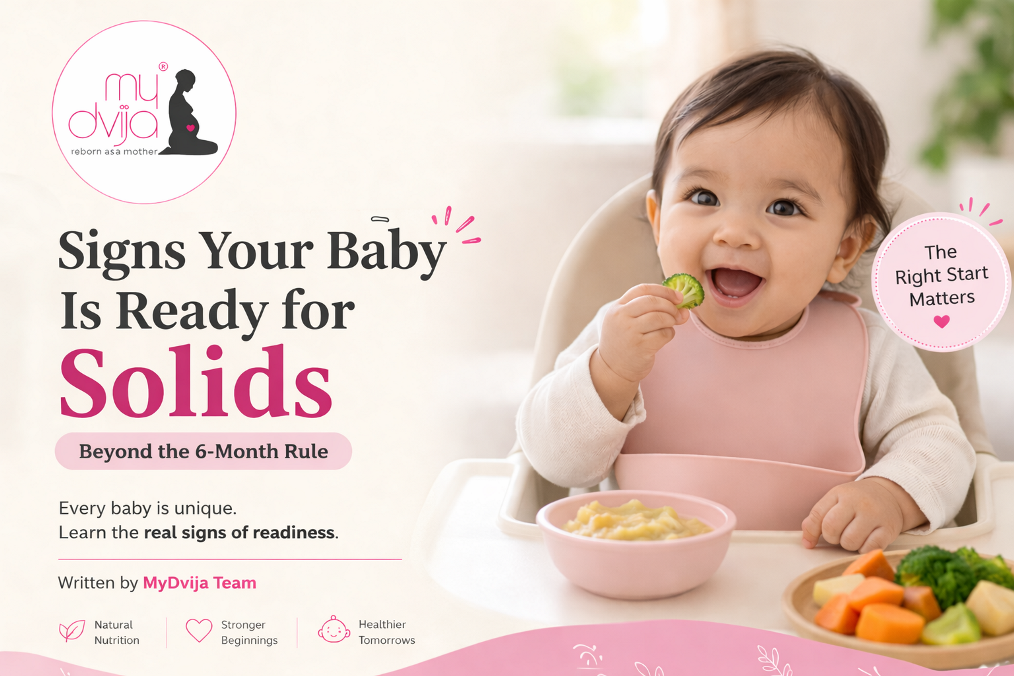
Signs Your Baby Is Ready for Solids — Beyond the 6-Month Rule

Signs Your Baby Is Ready for Solids — Beyond the 6-Month Rule
My baby turned exactly six months on a Tuesday. On Wednesday morning, my mother-in-law arrived with a small bowl of mashed banana and a look that said this was happening today.
And honestly? My baby wasn’t ready. He turned his head away, gagged on the tiniest bit, cried, and I ended up spending the afternoon on Google at 2am wondering if I’d somehow broken something.
Two weeks later, something had shifted. Same banana, same bowl, same baby — except this time he leaned forward and opened his mouth like he’d been waiting for it all along. That’s what readiness actually looks like.
The 6-month guideline is a minimum, not a starter pistol. Your baby’s body will tell you more than the calendar ever could — if you know what to look for.
Why the 6-Month Rule Exists (And What It Doesn’t Mean): –
The WHO recommends exclusive breastfeeding for 6 months, after which complementary foods can be introduced. Most paediatric associations align with this. The reason is solid: before 6 months, a baby’s gut is not mature enough to handle anything other than breastmilk or formula, and introducing solids too early is linked to increased allergy risk, digestive issues, and reduced breastmilk intake.
What the guideline doesn’t mean is that every baby hits a developmental switch at exactly 180 days. Some babies show clear readiness signs at 5.5 months. Others aren’t genuinely ready until closer to 7. The 6-month mark is the floor, not the signal.
Starting before 6 months — regardless of readiness signs — is not recommended. Starting a week or two after 6 months because your baby clearly isn’t ready yet? Completely fine.
The Three Signs That Actually Matter: –
There’s a lot of noise online about readiness signs. Some lists have 10 items. Some are vague enough to apply to any baby at any age. Paediatric consensus has narrowed it to three core signs, and all three should be present before you start:
1. Sitting up with minimal support and holding their head steady: –
This is not the same as being propped in a Bumbo seat. Your baby needs to be able to sit with only light support — a hand at the hip, say — and keep their head upright and stable. This matters because a baby who can’t control their head cannot safely manage food in their mouth. They can’t move it around, position it, or protect their airway properly. Head and trunk control is a non-negotiable prerequisite, not just a nice sign.
2. The tongue-thrust reflex has faded: –
Babies are born with a protective reflex that automatically pushes foreign objects out of their mouths with their tongues. This is what stops them from choking on things they shouldn’t have. It also, unfortunately, pushes food straight back out when you first try to spoon something in.
Between 4 and 6 months, this reflex naturally fades. You can test it simply: offer a clean finger or a tiny bit of water on a spoon. If it immediately gets pushed back out with the tongue, the reflex is still active and your baby isn’t ready yet. If they move it around their mouth and seem to manage it, the reflex is fading.
A lot of parents interpret the tongue-thrust reflex as “not liking the food.” It’s not dislike — it’s biology. There’s no point persisting when this reflex is still strong.
3. Showing genuine interest in food: –
Not just watching you eat — actually reaching toward your food, opening their mouth when food comes near, leaning forward with clear intent. This is different from general curiosity about objects (babies reach for everything at this age — your glasses, your phone, the TV remote).
The specific behaviour to look for: your baby watches food go from your hand to your mouth, tracks it, and makes a clear attempt to get some. That’s food-directed interest, and it’s meaningful. A baby who stares blankly at the ceiling while you eat is not showing food readiness — they’re just in the room.
Signs That Are NOT Indicators of Readiness: –
These come up constantly, and they cause a lot of unnecessary early starting. They’re worth addressing directly:
- Waking more at night: Almost every parent who starts solids early does so because their baby started waking more frequently and someone suggested “they need more food.” Night waking at 4–5 months is a developmental phase — the 4-month sleep regression — that has nothing to do with hunger and nothing to do with solids. Starting food at 4 months will not fix night waking. It will just give an immature gut more than it can handle
- Watching you eat: Babies at this age are fascinated by everything you do. Watching food being eaten is interesting. It is not the same as being ready to eat it
- Big baby or good weight gain: A larger baby does not have a more mature digestive system. Size and gut readiness are not related
- Chewing movements: Babies make chewing and mouthing movements from around 4 months as part of oral development. This is not a sign they’re ready for food — it’s just normal mouth exploration
- Family pressure: “Hamare zamane mein hum 4 mahine mein dete the” is not a readiness sign. It’s a different era with different guidance and, respectfully, different outcomes. The science has moved on
What About Starting Between 6 and 7 Months? :-
If your baby is 6.5 months and not showing clear readiness signs yet — relax. You have time. The window for introducing solids before 12 months is long. There’s no magical nutrient deficit that hits at 6 months and one day that breastmilk can’t cover for a few more weeks.
What you don’t want to do is wait past 7 months without starting at all. Research suggests that delaying beyond 7–8 months can increase the risk of food refusal and texture issues later. There’s also a window for allergen introduction that you don’t want to miss. So, the message is: don’t rush at 6 months if your baby isn’t ready. But don’t stall indefinitely either.
Once You See the Signs — What’s Next? :-
This is where most parents freeze. Okay, they seem ready. Now what do I actually give them? In what texture? How much? How often? Do I do purees or BLW? What if they gag?
These are exactly the questions the MyDvija Weaning & BLW free orientation answers — it’s free, it’s structured, and it covers readiness, first foods, the difference between traditional weaning and baby-led weaning, how to handle gagging safely, allergen introduction, and what to avoid. If you’re approaching the 6-month mark and feeling unready yourself, this is the most useful hour you’ll spend.
For the food itself — when you’re ready to start, MyDvija’s Nachani Satva (Sprouted Ragi) is one of the best first foods you can offer. It’s pre-sprouted, pre-ground, iron-rich, easy to digest, and takes three minutes to cook. No additives, no processing tricks. Just ragi.
The MyDvija Khichadi Mix is another strong early option — rice and lentils together make a nutritionally complete meal with excellent protein and iron, and the pre-ground mix means it cooks smooth without effort.
One More Thing Worth Saying: –
Starting solids is not a milestone race. Your cousin’s baby started at 5.5 months and is fine. Your neighbour waited until 7 months and their child eats everything. Individual variation is wide and normal.
What matters is that when you start, your baby is actually developmentally ready — not just old enough on paper, not pressured by the extended family lunch visit, not started because the paediatrician glanced at the calendar and said “you can begin now” without checking for the actual signs.
Watch your baby. They’ll tell you when it’s time. You just have to know what you’re looking for — and now you do.
Also Worth Reading: –
- The Truth About Packaged Baby Food (And What to Use Instead)
- Starting Solids: A Real Guide for Confused Indian Moms
- Toddler Food Strikes: Why They Suddenly Refuse Foods They Loved
- Weekly Meal Plan for Toddlers (That Won’t Drive You Crazy)
- Explore all blogs →