
Blog
Simple Activities That Build Your Baby’s Brain Before Age 1

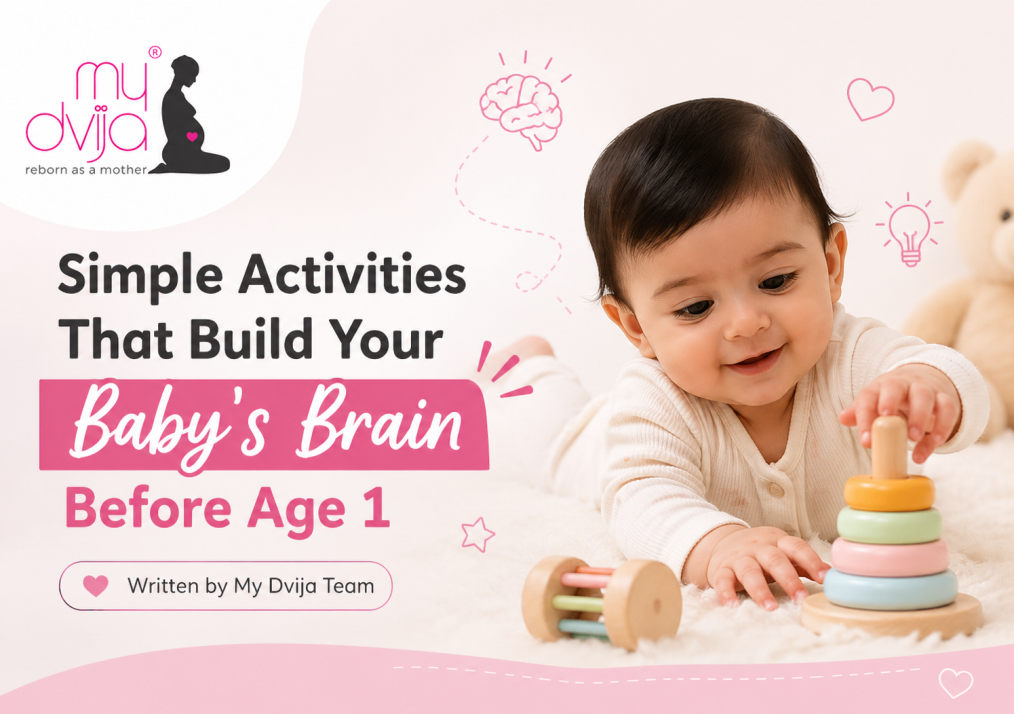
Simple Activities That Build Your Baby’s Brain Before Age 1
You don’t need flash cards. You don’t need a curriculum. You don’t need a dedicated sensory corner with Pinterest-worthy bins and matching labels.
What you need is already in your home, in your hands, and in the way you talk to your baby while you’re folding laundry at 6pm.
The first year of a baby’s life is one of the most important windows of brain development that will ever happen. More neural connections form in this period than at any other point in life. And the activities that drive that growth? They’re embarrassingly simple.
Here’s what actually works, broken down by age, with zero requirement for expensive toys or special equipment.
Watch Shrreya Shah break this down on our My Dvija YouTube Channel — real, practical parenting guidance without the overwhelm.
Why the First 12 Months Matter So Much
At birth, a baby’s brain is roughly 25% of its adult size. By the end of the first year, it has roughly doubled. That growth isn’t random — it’s driven by experience. Every time your baby sees a face, hears your voice, touches a new texture, or tracks a moving object, neurons fire and connect.
The science term is “serve and return” — baby reaches out (coos, reaches, looks), you respond, and that back-and-forth literally builds brain architecture. It’s less about what activity you’re doing and more about the fact that you’re doing it together, responsively.
No toy can replace that. But knowing which activities invite more of it? That’s genuinely useful.
Age-by-Age Activities (0–12 Months)
0–3 Months: The Basics Are Enough
At this age your baby’s vision is limited — they can see clearly about 20–30 cm in front of them. Faces are their favourite thing in the world. Language processing begins from birth.
- Talk to them constantly. A running commentary on what you’re doing — “I’m putting on your vest now, the blue one, yes this one” — is building language pathways. It doesn’t matter that they don’t understand yet.
- Make eye contact and wait. Look at them, smile, wait for a response. Even a tiny eyebrow movement counts. This is the original serve-and-return.
- Tummy time from day one (while awake and supervised). Just a few minutes at a time, multiple times a day. This builds neck, shoulder, and core strength that feeds into every future motor milestone.
- Skin-to-skin contact. Especially for newborns, being held against your skin regulates their nervous system and supports bonding hormones that make them more open to learning.
- Narrate the world. When you step outside, say “sun” and look up. When the dog walks in, say “dog” and point. You’re laying vocabulary before they can speak it.
What to skip: Screens, ‘educational’ videos, and anything that doesn’t involve you. At this age, you are the curriculum.
3–6 Months: Hello, World
Your baby is now reaching, tracking objects, and responding to your expressions with increasing intention. They’re also developing a sense of cause and effect — which is exactly what you want to play with.
- Put objects in their hands. A crinkle cloth, a wooden ring, a fabric swatch — anything safe to grip. Let them bring it to their mouth. That’s legitimate exploration.
- Make things move and make noise. Shake a rattle just within reach. Let them kick at a dangling toy. When they realize their action made something happen, you’ll see a little light go on.
- Sing. Doesn’t matter if you’re off-key. Your baby responds to the rhythm and your emotional tone before they understand words. Lullabies, Bollywood songs, nursery rhymes — all of it counts.
- Mirror play. Hold them in front of a mirror. They’ll be fascinated by the baby staring back at them — and also by your face next to theirs. Great for social development.
- Read anything. Board books, magazines, the back of a cereal box — they’re not tracking plot yet, they’re listening to your voice and looking at pictures with contrasting colours.
6–9 Months: Curious and Mobile
Sitting up changes everything. Now they can use both hands, look around more freely, and really explore objects. Their memory is developing — they’ll remember a person or toy from earlier in the day.
- Simple hiding games. Cover a toy with a cloth. Let them find it. This is teaching object permanence — the understanding that things exist even when they can’t see them. Peekaboo is doing the same thing with your face.
- Let them bang and dump. Give them a steel bowl and a spoon. Give them a container of soft objects to tip out. It feels messy and loud. It’s actually sensory and cause-and-effect learning.
- Encourage crawling, don’t rush walking. Crawling cross-pattern movement connects brain hemispheres and is important for reading and coordination later. Don’t skip it by keeping baby in a walker.
- Texture exploration. Smooth wood, soft fabric, bumpy silicone, cool metal. All of these teach the brain something different. Even touching grass outside counts.
- Imitation games. Stick out your tongue. See if they copy. Clap and see if they try. This is both social learning and motor learning happening at the same time.
9–12 Months: Little Problem Solver
They’re pulling up, maybe cruising, possibly saying their first words. They understand far more language than they can produce. They’re starting to solve simple problems intentionally.
- Stacking and nesting. Cups inside cups, blocks that balance, rings on a post. Trial and error is literally teaching spatial reasoning.
- Follow their lead. If they’re obsessed with a drawer, let them open and close it (within safety limits). If they’re fixated on your water bottle, narrate: “That’s mama’s bottle. Water is inside. Heavy!” Curiosity followed is curiosity deepened.
- Give them choices. “Do you want the red one or the blue one?” Hold out both. Even if they just swipe at one, they’re practising decision-making and you’re treating them like a thinking person.
- Introduce more books with words and routine. Point to pictures and name them consistently. Point to body parts. Wave goodbye when you leave the room so “bye bye” becomes meaningful.
- Simple music and movement. Bouncing them on your knee to a beat, swaying while you hold them, clapping games — rhythm and vestibular (balance) input are both brain food.
MyDvija Product — Want 100+ guided activities, all in one place?
The Dvija PlayBook (3 months–6 years) is a developmental activity book with over 100 interactive, age-appropriate play ideas designed for Indian homes and real-life parenting. No fancy equipment required — just you, your baby, and simple everyday objects. Rated 5 stars by parents.
If you want live guidance with a community of other parents, check out Play Date — 185+ Developmental Home Play Ideas — a live online course with Shrreya and team, covering sensory play, motor development, and age-appropriate activities across 15 interactive sessions.
The Indian Home Advantage (That Nobody Talks About)
Here’s something the parenting books written for Western contexts consistently miss: the Indian joint family setup is actually ideal for early brain development.
Your baby hearing multiple adults talking, in multiple languages or dialects, is neurologically rich. They’re mapping out that language has different sounds, rhythms, and patterns. Bilingual and multilingual babies show strong executive function skills later.
Dadi singing old film songs while rocking the baby? Brain stimulation. Nana-nani making funny faces? Social learning. Chacha making silly sounds? Auditory processing.
The ‘stimulation’ doesn’t have to come from a programme. It can just be life, happening around a curious baby who is paying attention to all of it.
What does matter: that you’re responding to them. Not constantly entertaining them, but noticing when they try to communicate — with a look, a sound, a reach — and responding. That responsiveness is what wires the brain, not the toy.
Brain Development Starts with Nutrition Too
If your baby is under 6 months and exclusively breastfed, your nutrition directly affects theirs. DHA (omega-3s) passes through breast milk and supports brain and eye development in the first year.
For mothers who are breastfeeding, the Essential Supplements Guide on MyDvija covers exactly what your body needs to support both you and your baby’s development.
Once your baby starts solids (around 6 months), brain-boosting foods become part of the picture. Nachani Satva (Ragi Flour) contains methionine and tryptophan — amino acids that support cognitive function and brain development. Easy to add to porridge, kheer, or rotis.
For a full recipe and meal guide from 6 months onwards, the Babies Yum Food Diary (eBook or Hardcopy) by MyDvija has 300+ recipes covering everything from 6 months to toddlerhood — including brain-nourishing foods with modifications for each age.
What You Can Actually Skip
Not flash cards. Babies under 12 months cannot process the rapid visual information or connect symbols to meanings in the way flash cards assume. They’re better off looking at your real face.
Not structured ‘sessions.’ Brain building at this age doesn’t happen in scheduled 20-minute activity windows. It happens during bath time, feeding, a walk outside, getting dressed. The ordinary moments are the education.
Not walkers. The research on baby walkers is fairly consistent — they can delay motor development and independent walking, and they’re also a safety hazard. A safe floor with space to roll and crawl does more.
Not constant stimulation. Babies need downtime to process what they’ve experienced. An overtired, overstimulated baby isn’t learning — they’re in survival mode. White space is part of the plan.
The Part, Nobody Tells You About Yourself
All of this works better when you’re not running on empty. And that’s genuinely hard to say to a parent who hasn’t slept properly since the baby arrived, who is fielding comments about whether the baby is eating enough, sleeping enough, hitting milestones on time.
You don’t need to be on all the time. You don’t need to be doing activities every waking moment. You need to be present some of the time, rested enough to respond when they reach for you, and not drowning in guilt about everything else.
A mother who takes a moment to sit still is not failing her baby. She’s sustaining the most important relationship that baby has.
You’re already doing more than you think. The fact that you read this entire blog is evidence of that.
Read More on MyDvija
These are worth reading next:
→ Baby Development — Understanding Your Baby’s Milestones — The full parenting archive
→ Essential Supplements for Mothers — Pregnancy, Breastfeeding & Postpartum — What your body (and your baby’s brain) needs right now
→ Power of Breastfeeding — Benefits for Mom & Baby — Including its role in early brain development
→ All Baby Care & Development Articles — Browse the full MyDvija blog
The Bottom Line
You don’t need to do more. You need to do less, but more intentionally. Talk to them. Respond to them. Let them touch things, taste things, watch things. Take them outside. Sing to them off-key. Follow their gaze.
The brain builds itself on connection and curiosity. You’re already providing both.
Want more support?
Follow our My Dvija on YouTube for free videos and real-talk parenting from Shrreya Shah — someone who has guided thousands of Indian mothers through exactly this phase.
Or visit mydvija.com for courses, the Dvija PlayBook, consultations, and products designed for where you are right now.
Your baby is lucky to have someone paying this much attention.