
Blog
Supplements for Newborn Babies — What Every Indian Parent Needs to Know

Supplements for Newborn Babies — What Every Indian Parent Needs to Know
The paediatrician handed me a prescription at my daughter’s one-week check-up. Vitamin D drops. Just that.
No explanation of why. No mention of when to give it, whether she needed anything else, or what signs to watch for if something was missing. I went home, googled everything, and ended up more confused than when I started — half the results were American, half the Indian ones contradicted each other, and none of them addressed the specific context of a breastfed Indian baby born into a family that lives primarily indoors.
This blog is what I wish someone had given me that week. The actual supplements newborns and babies need, why they need them, and what to do about it in the Indian context — clearly, without the confusion.
First — Does a Newborn Need Supplements at All? :-
The short answer: breastfed babies need vitamin D from birth and iron from 4 months. Formula-fed babies may need neither, because formula is fortified. But the details matter — and the details vary for Indian babies specifically.
Breast milk is the most perfectly designed food for a human newborn. It contains the right balance of protein, fat, carbohydrates, and most vitamins — particularly vitamins C, E, and all the B vitamins. It cannot, however, provide adequate vitamin D, because the mother’s own vitamin D status is typically insufficient, and because the quantity of vitamin D in breast milk is always low regardless of maternal levels.
This is not a flaw in breast milk. It’s a design feature that assumed babies would be in sunlight — which, in the evolutionary context where breast milk developed, they would have been. In modern Indian urban life — where babies are kept indoors, dressed in full clothing when outside, and mothers follow advice to keep newborns out of direct sun — the sunlight assumption breaks down entirely.
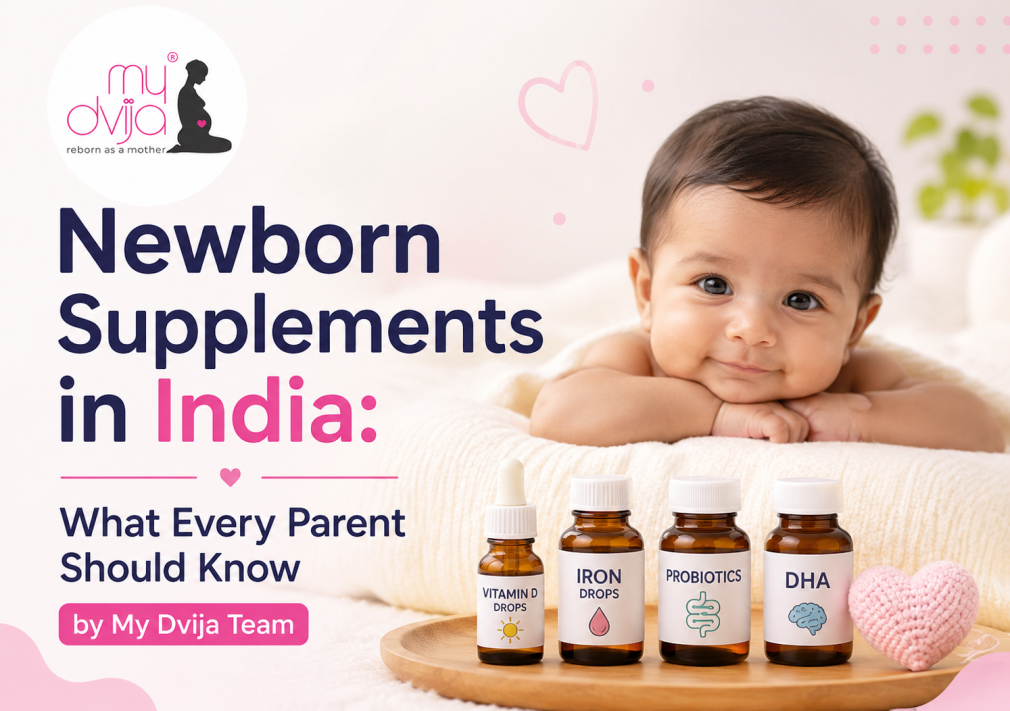
Supplement 1 — Vitamin D Drops: Required for All Breastfed Babies From Birth: –
This is the most important, most consistently recommended, and most commonly missed supplement for Indian newborns.
Why vitamin D matters for babies: –
- Bone development: vitamin D enables calcium and phosphorus absorption from the gut. Without adequate vitamin D, calcium cannot be deposited properly into growing bones — leading to rickets, a condition causing bowing of the legs, softening of the skull, and delayed tooth eruption. Rickets has been seeing a resurgence in India
- Immune function: vitamin D receptors are present on every immune cell. Deficiency significantly increases susceptibility to respiratory infections — relevant given India’s burden of childhood respiratory illness
- Neurological development: vitamin D is involved in brain development and myelination — the process of insulating nerve fibres that underpins cognitive function
- Muscle function: including the heart muscle. Severe vitamin D deficiency in infancy has been associated with cardiac complications
Why Indian babies are at particular risk: –
- Indian skin has higher melanin, which reduces vitamin D synthesis from sunlight — darker skin requires significantly more sun exposure to produce the same vitamin D as lighter skin
- Urban Indian babies are typically kept indoors or in shade, with minimal direct sun exposure
- Over 80% of urban Indian mothers are themselves vitamin D deficient, meaning breast milk vitamin D levels are already low at the starting point
- The traditional advice to keep newborns out of direct sun — while well-intentioned — removes the main natural source of vitamin D
- Studies in India have documented vitamin D deficiency in 50–90% of newborns depending on region
What the evidence recommends: –
The American Academy of Paediatrics (AAP), Indian Academy of Paediatrics (IAP), and WHO all recommend 400 IU (10 mcg) of vitamin D daily for all breastfed infants from the first few days of life, continuing until the baby is consuming adequate vitamin D from food and sunlight — typically until 12 months minimum, often beyond
- Formula-fed babies consuming more than 27 oz (approximately 800 ml) of formula daily typically receive adequate vitamin D through fortified formula and may not need additional drops — confirm with your paediatrician
- Babies on partial breastfeeding should still receive the full 400 IU supplement unless formula intake is very high
How to give vitamin D drops: –
- Liquid vitamin D drops are available at pharmacies — ask your paediatrician specifically for cholecalciferol (vitamin D3) drops, not ergocalciferol (D2), as D3 is more effective
- Dose: 400 IU daily, in a single drop or as directed on the specific product your paediatrician recommends
- Can be given directly into the baby’s mouth with the dropper, or placed on the nipple before a breastfeed
- Give at the same time every day — consistency matters more than timing
- Store as directed — many vitamin D drops need refrigeration after opening
Signs vitamin D deficiency may be present in your baby:
- Soft skull bones (craniotabes) — a crackling sensation when gentle pressure is applied
- Bowing of legs once the baby starts weight-bearing
- Delayed tooth eruption beyond 12 months
- Frequent respiratory infections in the first year
- Poor weight gain or muscle weakness
If any of these are present, ask your paediatrician for a 25-OH vitamin D blood test rather than assuming it will resolve on its own
Supplement 2 — Iron Drops: For Breastfed Babies From 4 Months: –
This is the supplement that surprises most Indian parents — the idea that a breastfed baby needs iron supplementation feels counterintuitive when breast milk seems so complete.
The reality: breast milk contains iron, but in amounts designed for the first four months, when a baby’s own birth iron stores are adequate. The iron in breast milk is highly bioavailable — better absorbed than any other source — but the quantity is insufficient for a growing baby’s needs once birth stores deplete
The iron timeline for babies: –
- Birth to 4 months: babies are born with iron stores accumulated in the third trimester of pregnancy (which is why premature babies need supplementation earlier). These stores, combined with the highly bioavailable iron in breast milk, are sufficient for the first four months
- 4–6 months: birth iron stores deplete as the baby grows rapidly. The iron in breast milk is no longer sufficient to meet the increasing demand. The AAP recommends 1 mg/kg/day of iron supplementation for breastfed babies from 4 months until iron-containing solid foods are introduced
- 6 months onwards: once solids are introduced, iron from food (ragi, dal, green vegetables, eggs for non-vegetarians) takes over, and supplementation can be discontinued if dietary iron is adequate
Special situations where iron supplementation starts earlier: –
- Premature babies: born before 37 weeks, with smaller iron stores — supplementation often begins at 2–4 weeks on paediatrician advice
- Low birth weight babies: similar reasoning to premature babies
- Babies of diabetic mothers: altered iron metabolism in utero may mean lower stores
- Twin pregnancies: iron stores are divided between two babies in the womb
- If the mother was severely iron-deficient during pregnancy: the baby may have been born with lower iron stores
Signs of iron deficiency in infants:
- Pallor — pale skin, pale inner eyelids, pale nail beds
- Unusual fatigue or lethargy
- Poor appetite
- Slow weight gain
- Delayed developmental milestones
- Frequent infections
The IAP recommends that all babies be screened for iron deficiency at 12 months. If your baby has any risk factors listed above, earlier screening is appropriate
Introducing iron-rich first foods at 6 months: –
The transition from iron drops to iron-rich foods at 6 months is one of the most important parts of starting solids. The best iron-rich first foods for Indian babies:
- Sprouted ragi (nachani): highest iron content of any grain, and sprouting makes it significantly more absorbable. MyDvija’s Nachani Satva (Sprouted Ragi) is pre-sprouted and ground — cooks in 5 minutes and is the simplest daily iron food for babies from 6 months
- Moong dal and masoor dal: introduced from 6 months, the iron base of the Indian baby’s solid food diet. MyDvija’s Khichadi Mix combines rice and dal in balanced proportions, already measured and ready to cook
- Moringa: from 6–7 months, a tiny pinch of MyDvija’s Moringa Powder added to dal or porridge provides iron, calcium, and vitamin C — which also enhances the iron absorption from the same meal
- Egg yolk: well-cooked, from around 7–8 months — a complete iron and fat source
- Green leafy vegetables: palak, methi, moringa leaves — cooked and pureed from 7 months
Always add vitamin C alongside iron-containing meals — a squeeze of lemon juice, a small piece of soft fruit alongside — to enhance iron absorption. This matters even for babies
Supplement 3 — Vitamin K: Given at Birth, Not Ongoing: –
Vitamin K is not an ongoing supplement — it is a single injection (or oral drops in some settings) given at birth to prevent Vitamin K Deficiency Bleeding (VKDB), also called haemorrhagic disease of the newborn.
Babies are born with very low vitamin K levels because it doesn’t cross the placenta efficiently, and breast milk contains low amounts. Without supplementation, some babies develop life-threatening bleeding — including intracranial (brain) bleeding — in the first days or weeks of life.
A single intramuscular injection of 1 mg vitamin K at birth provides protection for months while the baby’s own gut bacteria mature and begin producing vitamin K. This is standard practice in Indian hospitals but is sometimes refused by parents — it should not be refused. The evidence for vitamin K prophylaxis at birth is unambiguous and the risk of VKDB without it is real and serious
Supplement 4 — Probiotics: When Are They Needed? :-
Probiotics for babies are not universally recommended but are specifically indicated in certain situations:
- After antibiotic use: antibiotics prescribed to the baby (for infection) or to the breastfeeding mother disrupt the baby’s developing gut microbiome. A short course of infant probiotics — specifically Lactobacillus rhamnosus GG or Bifidobacterium infantis strains — can help restore balance
- C-section born babies: babies born by C-section miss the colonisation with vaginal and gut bacteria that occurs during vaginal delivery. Their gut microbiome is less diverse from birth. Probiotics in the early weeks may support microbiome development, though the evidence is still developing
- Colic and excessive crying: Lactobacillus reuteri DSM 17938 has the strongest evidence for reducing colic in breastfed infants — multiple trials showing reduced crying time
- Eczema prevention: in families with a strong history of atopic conditions, specific probiotic strains started in infancy have evidence for reducing eczema risk
For breastfed babies without the above indications: the breast milk itself is prebiotic and probiotic, containing human milk oligosaccharides (HMOs) that selectively feed beneficial bacteria and live bacteria that colonise the infant gut. Routine probiotic supplementation without specific indication is not necessary
Supplement 5 — Omega-3 / DHA: From Breast Milk or Formula: –
DHA (docosahexaenoic acid) is the omega-3 fatty acid critical for brain and eye development in infancy. In the first year, the brain grows at its fastest rate ever — from 25% of adult size at birth to 75% of adult size at 12 months. DHA is a primary structural component of brain tissue.
For breastfed babies: DHA comes through breast milk, and the DHA content of breast milk depends directly on the mother’s own DHA intake. A mother who eats flaxseeds, walnuts, or fatty fish regularly produces milk with adequate DHA. A mother with very low omega-3 intake produces milk with lower DHA. This is another reason the mother’s nutrition postpartum directly affects the baby’s development
For formula-fed babies: most standard infant formulas sold in India are now DHA-fortified. Check the label for DHA content
Separate DHA drops for babies: not routinely needed for breastfed babies whose mothers have adequate intake. If the mother’s diet is very low in omega-3s and she is not supplementing, discuss DHA drops with your paediatrician
What Newborns Do NOT Need: –
The supplement market for babies and young children in India has grown significantly and contains many products that sound necessary but aren’t. Saving you the money and the unnecessary anxiety:
- Gripe water: not recommended by any paediatric authority for infants under 6 months. Many commercial varieties contain alcohol, sugar, or herbal extracts not tested in newborns. For gas and colic, MyDvija’s Baby Tummy Roll On — with ginger, fennel, and peppermint oil applied externally in circles on the tummy — is a safer, effective alternative from birth
- Multivitamin syrups: marketed aggressively in India but not routinely needed for a well-nourished breastfed baby. They do not improve development in babies who are already adequately nourished, and some contain unnecessary additives and sweeteners
- Calcium supplements: not needed for babies who are breastfed or adequately formula-fed. Breast milk calcium is well-absorbed and adequate
- Tonics and ‘growth promoters’: including common Indian brands marketed for weight gain, appetite, and intelligence. These have no good quality evidence behind them and some contain concerning ingredients. Talk to your paediatrician before giving any
- Sugar-coated vitamin tablets: many children’s vitamins available in India contain more sugar than vitamins. For the supplements that are genuinely needed — vitamin D and iron — liquid drops are the appropriate form for infants
The MyDvija Approach — Natural Nutrition From 6 Months Onwards: –
Once your baby starts solids at 6 months, the transition from supplement to food-based nutrition is one of the most important feeding decisions you’ll make. MyDvija’s baby food range is built around exactly this: whole, traditional Indian ingredients that provide the nutrients growing babies actually need, without processing, additives, or the sugar that packaged baby foods typically contain:
- Nachani Satva (Sprouted Ragi) — iron, calcium, and fibre from sprouted finger millet. The first solid food and the daily iron food from 6 months
- Khichadi Mix — rice and dal balanced for complete protein and iron from 6 months
- Oats Powder — pre-ground for smooth porridge, fibre and iron-containing grain option from 6 months
- Multigrain Mix — multiple grains and pulses ground together for variety and nutritional density from 8 months
- Moringa Powder — a pinch in dal or porridge from 7 months provides iron, calcium, vitamin C together
- Wheat Teething Baked Sticks — whole wheat, jaggery, ghee, ajwain — iron-containing snack from 7–8 months
- Natural Jaggery Powder — iron-containing natural sweetener for baby food from 7 months, replacing refined sugar
- Dates Syrup — iron and B vitamins, a few drops in warm milk or porridge from 7 months
A Quick Reference Guide — Supplements by Age: –
Birth to 6 months: –
- Vitamin D drops: 400 IU daily — from the first few days of life, for all breastfed babies. Ask your paediatrician for the specific drops to use
- Vitamin K: single injection at birth — ensure this is given before leaving the hospital or birthing centre
- Iron: not yet required for full-term babies born to healthy, iron-replete mothers
- Probiotics: only if specifically indicated — after antibiotics, C-section delivery, or for colic
- Everything else: breast milk provides it
4 to 6 months: –
- Vitamin D: continue 400 IU daily
- Iron: 1 mg/kg/day iron drops for breastfed babies — discuss specific product with your paediatrician
- Formula-fed babies: check formula label for iron and vitamin D content before supplementing
6 months onwards (with solids): –
- Vitamin D: continue until dietary and sunlight sources are adequate — typically through 12 months minimum
- Iron: transition from drops to iron-rich first foods — ragi, dal, moringa, green vegetables
- Omega-3 / DHA: through breast milk (mother’s diet) or DHA-fortified formula
- All other nutrients: from a varied, well-planned solid food diet
When to Speak to Your Paediatrician: –
These situations warrant a discussion with your doctor rather than self-supplementation:
- Your baby was premature (born before 37 weeks)
- Your baby was low birth weight (under 2.5 kg)
- Your baby is not gaining weight on the expected growth curve
- Your baby seems unusually pale, lethargic, or unwell at any point
- Your baby has received antibiotics or you have during breastfeeding
- Your baby has had repeated infections in the first 6 months
- You have concerns about your own vitamin D, iron, or B12 levels while breastfeeding
For questions about your baby’s specific nutritional needs — especially in the context of introducing solids, transitioning from supplement to food-based iron, or managing a baby who was born premature or with low birth weight — a 30-minute consultation with Shrreya Shah provides personalised guidance from an experienced childbirth educator and mother wellness specialist
Shrreya Shah covers newborn care, baby nutrition, and starting solids in practical detail on the MyDvija YouTube channel — subscribe for free, accessible guidance in Hindi for every stage of your baby’s first year
Also Worth Reading: –
- The Truth About Packaged Baby Food (And What to Use Instead)
- Signs Your Baby Is Ready for Solids — Beyond the 6-Month Rule
- Ragi for Babies — When to Start and How to Make
- Nutrients Required by Mother After Delivery — Complete Indian Postpartum Nutrition Guide
- Iron Deficiency in Indian Women — Signs You’re Ignoring
- Subscribe to the MyDvija YouTube channel →
- Explore all blogs →
The paediatrician was right to prescribe vitamin D. What would have helped is understanding why — and knowing that it was one piece of a larger nutritional picture that includes iron at 4 months, food-based iron at 6 months, and a transition from supplement to whole traditional Indian food that is entirely achievable and significantly better than anything in a commercial tin.
Your baby needs very little from a supplement aisle. What they need most in the first year is you — well-nourished, informed, and confident. The vitamin D drops, the iron at 4 months, and the sprouted ragi porridge at 6 months. That’s the whole list. Everything else follows from there.