
Blog
Getting Your Period Back After Baby

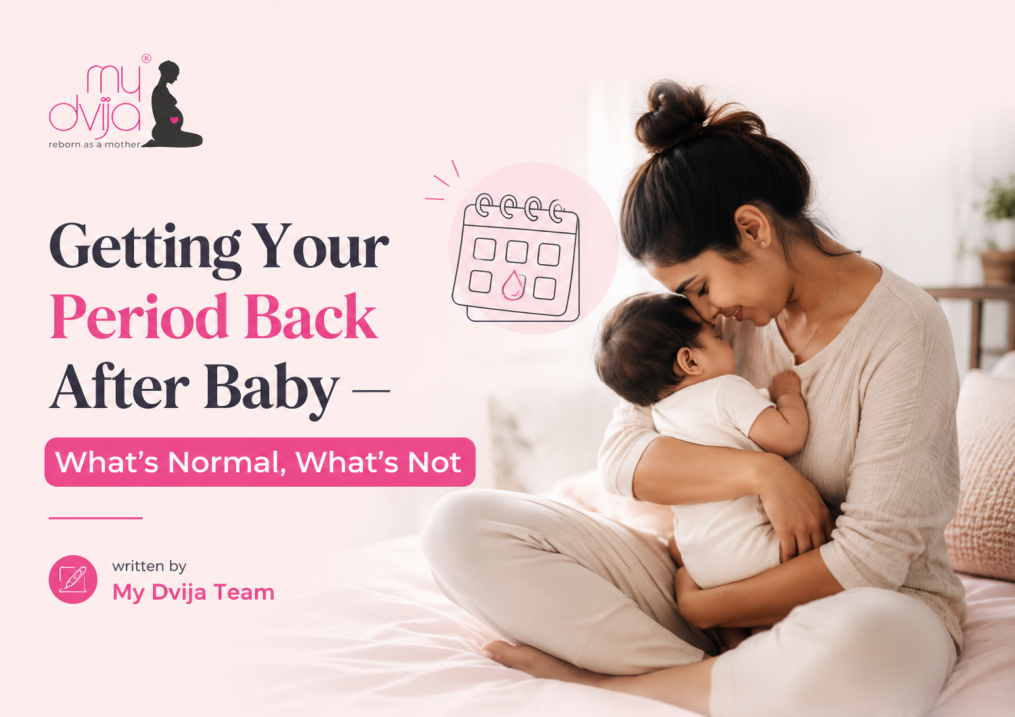
Getting Your Period Back After Baby — What’s Normal, What’s Not
My period returned at 14 months postpartum. I was still breastfeeding, mostly at night, and completely unprepared. No warning, no warning signs, just — there it was, on a Tuesday, while I was in a white salwar.
Two friends who delivered around the same time as me got theirs back at 6 weeks and 8 weeks respectively — both formula feeding. Another was still waiting at 18 months despite having weaned completely at 9 months.
The postpartum return of menstruation is one of the most variable things that happens to a woman’s body after birth, and also one of the least explained. The range of what’s normal is genuinely wide. But within that range, there are things worth knowing — about timing, about what the first few periods might feel like, about what actually needs medical attention, and about what your cycle returning means for fertility.
Here’s the full picture.
Why Your Period Disappears After Birth: –
During pregnancy, oestrogen and progesterone are at their highest levels ever. They suppress ovulation entirely. After delivery, both hormones drop sharply — progesterone crashes within hours, oestrogen within days.
But the hormone that determines when your period returns is prolactin — the hormone responsible for milk production. Prolactin suppresses the hormonal signals that trigger ovulation. As long as prolactin remains elevated, the cycle stays suppressed. This is why breastfeeding delays the return of periods — the more frequently a baby feeds, the higher prolactin stays, and the longer ovulation is suppressed.
This is also the basis of LAM — Lactational Amenorrhea Method — the natural contraception that relies on exclusive breastfeeding to prevent ovulation. It’s roughly 98% effective when used correctly: the baby is under 6 months, exclusively breastfed (no formula, no solids, no long gaps between feeds), and the period has not returned. All three conditions must hold for it to be reliable.
When to Expect Your Period Back — The Realistic Range: –
Formula feeding or not breastfeeding: Most women get their period back between 6 and 10 weeks after delivery. Some as early as 4 weeks, some closer to 12.
Exclusively breastfeeding: The period typically stays away until 6 months or later — often much longer. Many exclusively breastfeeding mothers don’t see their period until they begin reducing feeds or introducing solids, which lowers the frequency of nursing and therefore drops prolactin levels.
Mixed feeding: Somewhere in between, depending on the balance of breast and formula feeds. The more breastfeeds in a 24-hour period, the later the period tends to return.
After weaning: Once breastfeeding stops completely, prolactin drops and the cycle typically resumes within 6 to 8 weeks. But some women wait longer — the hormonal recalibration after extended breastfeeding can take 2–3 months.
What matters: none of these are rules. They’re averages. A fully breastfeeding mother getting her period at 8 weeks is unusual but not abnormal. A formula-feeding mother waiting 4 months is also not abnormal. If you’re outside the typical range and concerned, that’s worth discussing with your doctor — but the range itself is genuinely wide.
Lochia — The One Thing People Confuse with Their Period: –
After delivery, you’ll have postpartum bleeding called lochia. This is not a period. It’s the shedding of the uterine lining and other tissue from the pregnancy, and it typically continues for 4 to 6 weeks after birth — starting as red, heavy flow, gradually lightening to pink and then yellowish-white discharge.
Lochia can confuse women into thinking their period has returned quickly. The distinguishing features: lochia doesn’t follow a cycle, it doesn’t stop and start the way a period does, and it gradually tapers rather than ending cleanly. If you’re 2 weeks postpartum and bleeding heavily, that’s still lochia — not a period.
If lochia suddenly becomes bright red and heavy again after it had lightened — especially if you’ve been doing too much physically — that’s your body signalling to slow down. Rest, reduce activity, and call your doctor if it doesn’t settle within 24 hours or if you’re soaking more than a pad per hour.
The Dvija Dhoop Powder — used for uterine healing through the hot fermentation method — supports recovery of the uterus and surrounding tissues in the postpartum period. It can be used from the first week after delivery and many midwives and postpartum care practitioners recommend it specifically during the lochia phase to support uterine involution.
What Your First Period Back Might Actually Feel Like: –
Most women expect their first postpartum period to be a return to what their cycle was before. It almost never is — at least not immediately.
Common things about the first postpartum period:
- Heavier than pre-pregnancy periods — the uterus has been through significant stretching and the lining may be thicker at first
- More cramping — especially if you had minimal cramping before. The uterus is still recalibrating its contractile function
- Longer duration — the first period often lasts 7–10 days versus the 4–5 days many women were used to before
- Clots — small clots in the first postpartum period are common and usually normal. Clots larger than a 50-rupee coin, or soaking more than a pad per hour for two consecutive hours, warrant a call to your doctor
- Irregular cycle length — the second and third periods may not come on a predictable schedule. Cycles of 21 days followed by 45 days are common while the hormonal rhythm re-establishes itself
This irregularity usually settles by the third or fourth cycle. If it doesn’t — if periods remain consistently very heavy, very painful, or extremely erratic beyond 4–6 months of their return — that’s worth investigating for conditions like thyroid dysfunction, which is more common postpartum than most women realise, or for retained products of conception in very rare cases.
The Breastfeeding and Period Overlap — What Nobody Explains Clearly: –
Something that surprises a lot of breastfeeding mothers: when the period returns, milk supply often dips slightly in the days leading up to and during menstruation. This is due to the hormonal fluctuation — oestrogen rise in the second half of the cycle can temporarily affect milk composition and volume.
The baby may feed more frequently during this time, or seem unsettled at the breast. This is temporary — supply typically rebounds within a few days of the period ending. It can feel alarming if you don’t know it’s coming, particularly if you’ve had supply concerns previously.
What helps during the menstrual dip in supply:
- Increase feeding frequency — the demand signal is what brings supply back
- Stay well hydrated and well-fed in the week before your period — the body’s nutritional demands increase pre-menstrually and this affects milk
- The Dvija Breastmilk Booster — which supports hormonal balance alongside lactation — is particularly useful in this phase. It contains ingredients that stabilise postpartum hormonal fluctuation, which directly supports supply consistency through the menstrual cycle
Can You Get Pregnant Before Your Period Returns? :-
Yes. This is probably the most important thing in this entire blog.
You ovulate before your period arrives. If you haven’t had a period since delivery, you have no way of knowing from a missed period alone that you’ve ovulated and conceived. Women get pregnant postpartum without ever having had a period return because they ovulate, conceive in that first cycle, and don’t realise it until they miss what they were waiting for.
The rule: if you’re sexually active and not actively using contraception, do not assume that the absence of periods means you’re not fertile. LAM provides protection only under the very specific conditions described earlier. Outside those conditions — particularly once your baby is over 6 months, or any formula or solids have been introduced, or there are regular gaps between feeds — you are potentially fertile.
This conversation is worth having with your doctor at your 6-week postpartum check — specifically about contraception options that are compatible with breastfeeding, if that’s relevant to you. Progesterone-only pills, copper IUDs, and barrier methods are all options that don’t affect milk supply. Combined oral contraceptives (oestrogen-containing) can reduce supply and are generally not recommended for breastfeeding mothers in the early months.
Supporting Hormonal Recovery Through Nutrition and Herbs: –
The hormonal recalibration after pregnancy and delivery is significant, and nutrition plays a direct role in how smoothly it happens. Several nutrients are particularly important:
- Iron: heavily depleted by delivery and lochia, and low iron is one of the most common causes of heavy, irregular, or painful postpartum periods. Dal, leafy greens, red meat, eggs — iron-rich foods are non-negotiable in the postpartum diet
- Calcium and magnesium: both involved in uterine muscle function and hormonal regulation. Depleted by breastfeeding in particular
- Healthy fats: sex hormones — oestrogen, progesterone — are synthesised from cholesterol. A very low-fat diet actively impairs hormonal recovery
The Dvija Natural Shatavari is the most established Ayurvedic herb for female reproductive health. Shatavari supports hormonal balance, uterine health, and reproductive recovery. It’s safe from 20 weeks of pregnancy, through breastfeeding, and into the postpartum period. Many Indian women have used it for generations as the foundational herb for everything related to the female reproductive system — and the research increasingly supports its adaptogenic, hormone-supporting properties.
The Dvija Post-Delivery Low-Fat Mixture — a blend of 20+ ingredients formulated for postpartum recovery — provides the iron, calcium, and complex nutrition that underpins hormonal healing alongside physical recovery. It can be taken from one week after delivery and continues to be relevant long after the immediate postpartum phase.
When to Actually See a Doctor: –
Most of what happens with the postpartum return of periods is within normal range and resolves on its own. But there are situations that warrant medical assessment:
- No period by 3 months postpartum if not breastfeeding.
- No period by 6 months after completely weaning.
- Periods that are consistently soaking more than a pad per hour for several hours.
- Periods lasting longer than 10 days consistently after the first two or three cycles.
- Severe pain that doesn’t respond to standard pain relief — this can indicate endometriosis, which can present or worsen postpartum.
- Cycles that remain wildly irregular — less than 21 days or more than 45 days — beyond 6 months of return.
- Symptoms of thyroid dysfunction alongside irregular periods: persistent fatigue, hair loss beyond the postpartum phase, weight changes, feeling cold all the time, mood changes that don’t improve.
Postpartum thyroid dysfunction affects around 5–10% of women and often goes undiagnosed because its symptoms overlap with normal new-mother exhaustion. If you’re ticking several of those boxes at 9–12 months postpartum, a thyroid panel (TSH, Free T3, Free T4) is worth asking your doctor about.
If You’re Unsure What’s Normal for You: –
Hormonal recovery is individual. What your period looks and feels like in the first year after birth depends on your delivery, your breastfeeding history, your nutrition, your sleep, your stress levels — and your baseline hormonal profile before pregnancy.
If you want to understand what you’re experiencing in the context of your specific postpartum journey — including breastfeeding, nutrition, and hormonal health — a 30-minute consultation with Shrreya Shah is the most efficient way to get answers that are actually relevant to your situation.
My Dvija covers postpartum recovery, hormonal health, and breastfeeding questions in detail on our MyDvija YouTube channel — browse the postpartum playlist for free guidance in Hindi.
Also Worth Reading: –
- Why Your Body Looks Different After Birth (And Why That’s Okay)
- The Fourth Trimester — What No One Tells You
- Postpartum Weight Loss: Real Talk for Indian Moms
- Essential Supplements for Mothers
- Subscribe to the MyDvija YouTube channel →
- Explore all blogs →
Your cycle returning is your body signalling that the acute phase of postpartum recovery is settling. It’s not a return to exactly where you were before — hormonally, physically, or in any other way. But it’s a milestone, and one that deserves to be understood rather than just endured.
The white salwar incident taught me to keep a period kit in my bag again after 14 months of not needing one. Consider this your advance warning.