
Blog
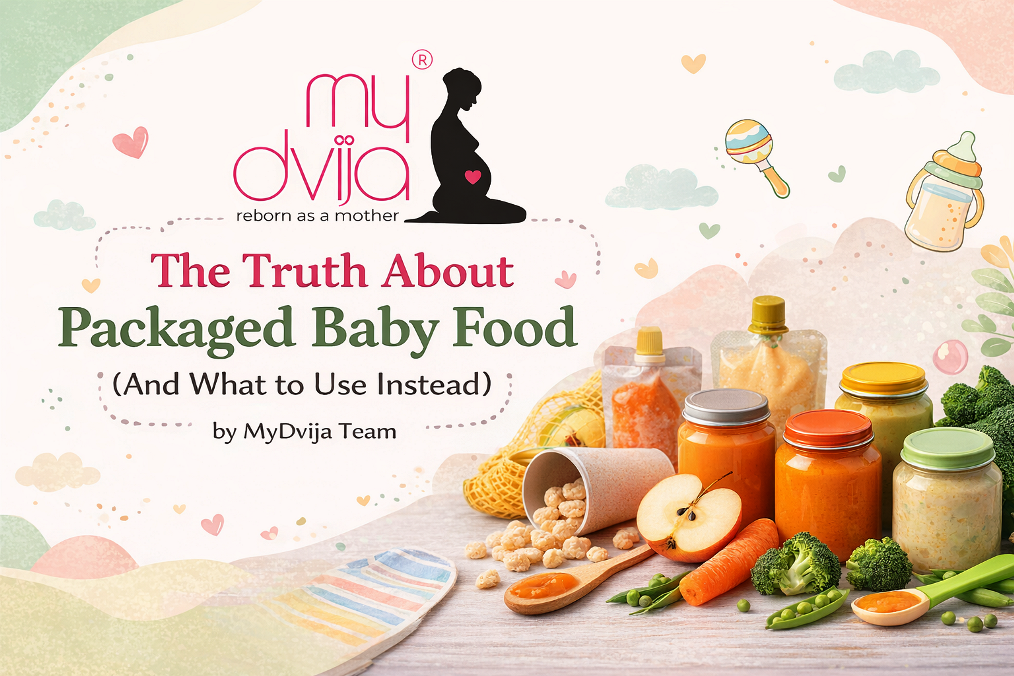
The Truth About Packaged Baby Food (And What to Use Instead)

The Truth About Packaged Baby Food (And What to Use Instead)
My baby turned six months and I did what most urban Indian parents do — I walked into a medical store and bought three different branded baby cereals. The packaging had happy babies on it. One said “stage 1.” Another said “organic.” A third said “multigrain with DHA.”
I felt very organised.
A few weeks later, I actually read the ingredients list. Properly. And what I found was… not what the front of the box had suggested.
This is not a post designed to make you feel guilty about what you’ve already given your baby. Most of us have used packaged food at some point, and the convenience is real. But I think parents deserve an honest look at what’s actually in these products — and a practical alternative that doesn’t require you to become a full-time baby chef.
What the Labels Don’t Tell You Upfront: –
The front of a packaged baby food box is a marketing exercise. The back — specifically the ingredients list — is where the truth lives. Here’s what you’ll commonly find when you look closely:
1. Sugar, hiding under other names: –
Maltodextrin is probably the most common offender. It’s a highly processed carbohydrate derived from starch — usually corn or wheat — and it has a glycaemic index higher than table sugar. It’s in dozens of baby cereals and biscuits marketed as “no added sugar.” Technically accurate. Practically misleading.
Other names for the same thing: dextrose, glucose syrup, corn syrup solids, “natural flavours” (which can contain sweeteners). If your baby food has any of these in the first five ingredients, you’re looking at a sweetened product — just not one that says so clearly.
2. Excess sodium: –
A baby’s kidneys are still developing and cannot process high sodium loads. Most packaged savoury baby foods — those little pouches of pureed vegetables and mixed meals — contain significantly more sodium than home-cooked equivalents. Babies don’t need salt added to their food at all before 12 months. The amount in some packaged products exceeds what’s appropriate for an entire day in a single serving.
3. Ultra-processing: –
Processing destroys nutrients. When a grain is refined, extruded, dried, and then “fortified” with synthetic vitamins to replace what was lost — what you end up with is a food that looks nutritious on the label but delivers far less to your baby’s body than the original whole ingredient would have. The “iron fortified” on the box sounds reassuring. But iron from a fortified processed product has much lower bioavailability than iron from actual food.
4. Starch fillers: –
Many baby cereals are primarily refined starch. They bulk out the product, they’re cheap, and they make babies feel full quickly — which is also why babies who eat a lot of packaged food often have less appetite for more varied, nutritious whole foods. It’s not fussiness. It’s physics.
But My Baby Seems Fine…: –
They probably are. I want to say that clearly.
The problem with early nutrition isn’t usually visible immediately. A baby who eats packaged food every day doesn’t look unwell in the short term. The concerns are about what those first thousand days of eating lay down — taste preferences, gut microbiome diversity, the association between food and flavour versus food and sweetness.
Babies who are introduced to a wide variety of real foods, real textures, and real tastes in the first year tend to be less fussy eaters later. Babies who eat mostly smooth, sweet, processed foods in their first year sometimes struggle with expanding their palate at 18 months or 2 years — and that’s when the meal-time battles begin.
It also matters that the packaged food habit is extremely easy to maintain and extremely hard to break once set. Convenience becomes the default. And then suddenly you have a 3-year-old who only eats things from packets.
What Indian Babies Actually Ate Before Packaged Food Existed: –
Not that long ago — one generation, maybe two — there was no such thing as commercial baby food in India. Babies ate thinned dal, soft khichdi with ghee, mashed banana, soaked and ground ragi porridge, soft-cooked sabzi without spice. Rice water. Aam ras. Whatever the family cooked, made softer.
These weren’t just culturally familiar foods — they were nutritionally complete, regionally appropriate, and completely free of the preservatives, fillers, and processing that modern packaged food involves.
Our grandmothers didn’t have “stage 1” and “stage 2” baby food. They had common sense, a few traditional recipes, and babies who grew up eating everything the family ate by age one.
We’ve somehow convinced ourselves that this approach — the original approach — requires special knowledge or effort. It doesn’t. It requires less effort than reading ingredient labels on six different products at the medical store.
What to Use Instead — Actually Practical Options: –
For 6–8 months (first foods): –
- Ragi (finger millet) porridge — soak, sprout, if possible, dry, grind, cook with water or breastmilk. MyDvija’s Nachani Satva (Sprouted Ragi) is already sprouted and ground — you just cook it. No processing, no additives, ready in minutes
- Soft khichdi — rice and moong dal in equal parts, pressure cooked until very soft, thinned with water. Add a drop of ghee. That’s it. MyDvija Khichadi Mix takes this further with a multigrain blend that’s already balanced
- Mashed banana, steamed apple, soft pear — no recipe needed
- Oats porridge — just oats, water, and breastmilk or formula. MyDvija Oats Powder is pre-ground so it cooks smooth without any lumps — useful for those early days when texture is still unfamiliar
For 8–10 months (more texture, more variety): –
- Soft-cooked dal chawal with ghee
- Mashed sabzi — lauki, gajar, sweet potato — cooked without salt or spice
- The MyDvija Multigrain Mix works well here — multiple grains and pulses ground together, easy to make into a porridge or a thicker pudding depending on how much water you use
- Egg yolk, well-cooked — one of the best iron and fat sources for babies at this stage
For 10–12 months (family food, adapted): –
- Whatever you’re eating, made softer and without excess salt or chilli
- The Dvija Satvik Mix and Dvija Nutrie Daliya are both excellent at this stage — they’re whole grain blends that can be made into porridge or upma-style meals depending on the consistency you choose
- For a natural sweetener when needed — skip sugar entirely. Dvija Natural Jaggery Powder or Dvija Dates Syrup are both iron-rich alternatives that don’t spike blood sugar the way refined sugar does
For snack time and teething: –
- Instead of packaged biscuits full of refined flour and sugar — MyDvija Wheat Teething Baked Sticks are baked, not fried, with no added sugar or preservatives. Actually, does what teething snacks are supposed to do
And across all stages — ghee. A small amount of Dvija Cow Ghee (Vedic Style) in every meal is one of the most underrated things you can do for your baby’s brain development and fat-soluble vitamin absorption. The fear of fat in baby food is completely misplaced — babies need healthy fats more than almost any other age group does.
What About the Convenience Argument? :-
Fair point. You’re sleep-deprived, you have a baby who’s ready to eat right now, and the last thing you want to do is soak ragi overnight.
This is exactly why MyDvija’s range exists. Everything is already cleaned, ground, sometimes sprouted, and ready to cook in five to ten minutes — without the additives, without the maltodextrin, without the excess sodium. It’s the closest thing to homemade without actually having to make it from scratch every time.
Browse the full Baby/Toddler Food range here — there’s something useful for every stage from 6 months to toddlerhood.
Still Figuring Out How to Start Solids? :-
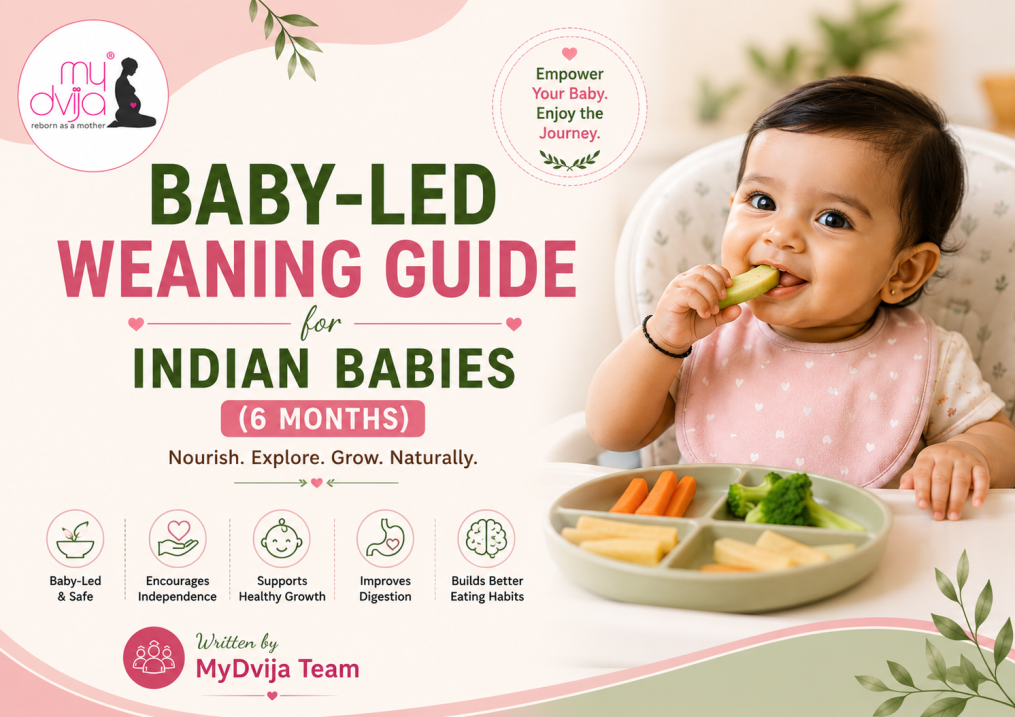
If your baby is approaching six months and you’re not sure where to begin — what to give first, what consistency, whether to do purees or BLW, how to handle allergies — the MyDvija Weaning & BLW course has a free orientation session that covers the basics clearly. No fluff, no conflicting advice — just a structured approach to starting solids that makes sense for Indian families.
Also Worth Reading: –
- Starting Solids: A Real Guide for Confused Indian Moms
- Toddler Food Strikes: Why They Suddenly Refuse Foods They Loved
- Weekly Meal Plan for Toddlers (That Won’t Drive You Crazy)
- Explore all blogs →
You don’t have to choose between feeding your baby well and having a life. The options exist. The knowledge exists. The products exist.
Reading the back of the box is a five-second habit. Once you do it a few times, you won’t be able to stop. And once you stop buying the ones that don’t pass the test, you’ll realise how much of the baby food aisle you can walk past without a second glance.
Your baby’s first foods are setting the foundation for every eating habit that follows. It’s worth getting right — and it’s not as complicated as the industry would like you to think.