
Blog
Why Your Body Looks Different After Birth

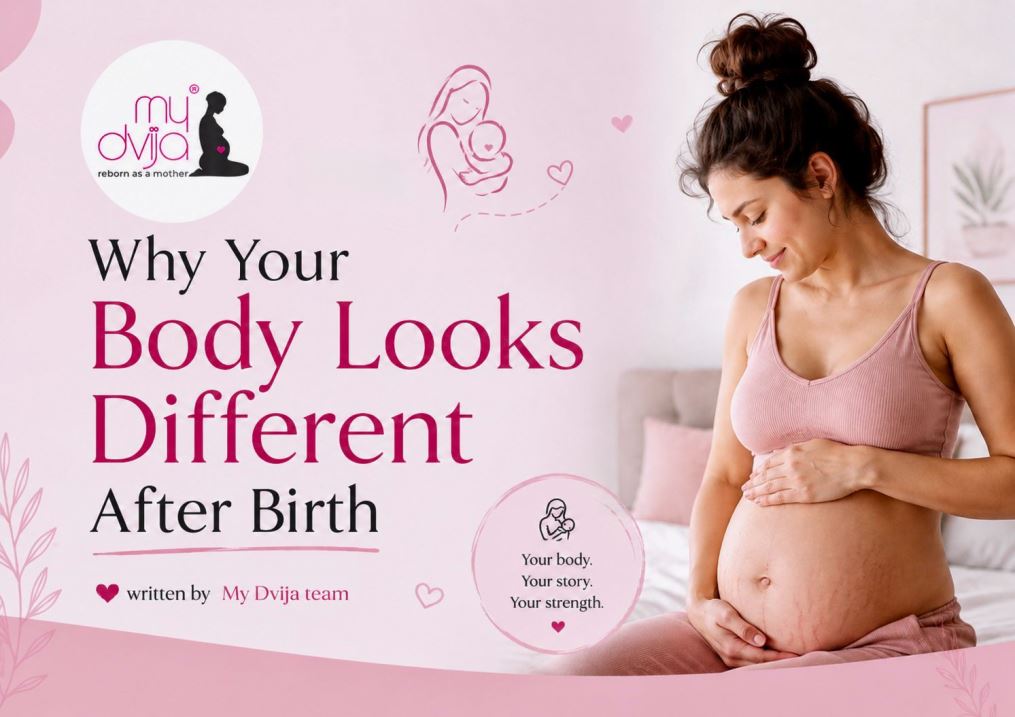
Why Your Body Looks Different After Birth (And Why That’s Okay)
About three weeks after I had my daughter, I made the mistake of looking at myself properly in the mirror for the first time.
Not a quick glance while brushing my teeth. A real look. And what I saw didn’t look like me. The stomach that hadn’t flattened back. The skin looser than before. Stretch marks I hadn’t seen forming because I’d been too busy existing through the third trimester to notice. My face looked different — fuller, more tired, something about the eyes.
I knew, intellectually, that my body had just grown and delivered a human being. But knowing something and feeling okay about it are not the same thing. And nobody had told me specifically — not my doctor, not my mother, not a single one of the pregnancy books I’d read — what was going to happen to my body after, and why, and what was permanent and what wasn’t.
This is that conversation.
The Stomach That Isn’t Going Back to Where It Was (Yet): –
The single most common thing new mothers are shocked by is the stomach. You deliver the baby and the bump doesn’t go with them. You still look pregnant. Sometimes for weeks.
This is completely normal and here is exactly why it happens.
During pregnancy, the uterus grows from the size of a pear to roughly the size of a watermelon. After delivery, it starts contracting back — a process called involution — but this takes around six weeks minimum to complete. In those weeks, the abdomen is still physically distended because the uterus is still large. You can actually feel it — a firm mass in the lower abdomen — if you press gently.
On top of that: the abdominal muscles that spent nine months stretched outward don’t snap back immediately. They’ve been under sustained load. Getting them to function as a unit again takes deliberate, specific movement — not crunches, which can actually worsen the separation, but specific core-rehabilitation exercises.
And then there’s diastasis recti — the separation of the two bands of abdominal muscle along the midline that happens in most pregnancies to varying degrees. If you notice a ridge or soft dip running vertically down the middle of your belly when you sit up, that’s likely diastasis. It doesn’t mean something went wrong. It means your body accommodated a baby. But it does mean the abdomen won’t respond to regular exercise the way it did before until that separation is addressed properly.
What actually helps: Specific postpartum core work — diaphragmatic breathing, transverse abdominal engagement, pelvic floor activation — starting gently from about 6 weeks postpartum for a vaginal delivery, or 8–12 weeks for a C-section. Not a gym programme. Not crunches. Specific, sequenced rehabilitation.
MyDvija’s Strength Exercises + Diet + Emotional Health for New Mothers course covers exactly this — safe postpartum exercise designed for Indian women, at home, during nap times, without equipment. It includes the specific core rehabilitation work for diastasis alongside nutrition and emotional health support, because the three are more connected than most fitness content acknowledges.
The Dvija Post Delivery Belt supports the abdomen as it recovers — not to speed up weight loss, but to give the muscles and ligaments structural support during the weeks they’re re-learning how to hold things in place. The traditional Indian practice of binding the abdomen after delivery has exactly this functional purpose behind it.
Stretch Marks — What They Are and What Actually Helps: –
Stretch marks are scars. Not surface-level skin discolouration — actual scars, formed when the middle layer of skin (the dermis) tears under rapid stretching that the skin can’t keep pace with. The collagen and elastin fibres rupture, and the body repairs them with scar tissue.
In the first months they appear red, pink, or purple — the colour of fresh scar tissue with blood supply. Over 6–12 months, they fade to silver or white as the scar matures and the blood supply recedes. They don’t disappear entirely. Nothing makes them disappear entirely, despite what skincare marketing suggests. What you’re working with is how visible they become and how the skin quality feels around them.
What genuinely helps: –
- Consistent massage — the act of massaging the skin improves circulation, stimulates collagen production in the surrounding tissue, and improves the texture and suppleness of the skin around the marks even if the marks themselves don’t disappear
- Starting early — addressing fresh stretch marks when they’re still red/pink gets better results than addressing old silver ones, because the scar tissue is still actively remodelling
- Ingredients that are actually evidence-based: vitamin E, hyaluronic acid, centella asiatica (gotu kola), and retinoids (not for breastfeeding mothers) have the most research behind them for scar improvement
The Dvija Mom’s Ubtan is formulated with traditional Ayurvedic herbs including chandana, manjishtha, and masur dal flour — all of which have skin-brightening, circulation-improving, and exfoliating properties. Used with regular massage (15–20 minutes on stretch mark areas), it improves skin texture and tone over time. It also addresses postpartum pigmentation — the darkening of the linea nigra and skin around the face and neck that many women notice after delivery.
The Dvija Mothers Post Delivery Massage Oil — used daily for at least 40 days after delivery as part of the traditional postpartum care practice — improves skin moisture, reduces dryness, and provides the circulatory benefits of regular massage to the whole body. Not a luxury. A functional part of physical recovery.
The Hair Loss at 3 to 4 Months: –
This one ambushe people because it happens months after delivery, when you thought the major physical changes were behind you.
During pregnancy, elevated oestrogen keeps hair in its growth phase longer than usual — so you lose less, and your hair looks fuller than normal. After delivery, oestrogen drops sharply and all that hair that should have been shed during pregnancy starts shedding at once. This is called telogen effluvium and it typically peaks around 3–4 months postpartum.
It is alarming. Clumps in the shower drain, on the pillow, on the baby. Most women lose noticeably more hair for 2–5 months before it stabilises and begins to regrow. It almost always resolves on its own by 9–12 months.
What helps while it’s happening:
- Nutrition — hair loss is worsened by iron deficiency, which is common postpartum. Eating iron-rich foods (dal, leafy greens, red meat, eggs) and ensuring adequate protein intake supports the regrowth cycle
- Scalp massage — improves circulation to the follicles, which supports the regrowth phase even while the shedding continues
- Avoiding heat and tight styling during this phase — the hair that’s actively in the shedding cycle is more fragile than usual
The Dvija Kesh Powder is an Ayurvedic scalp treatment made specifically for postpartum hair fall — massaged into the scalp, it strengthens the follicles and supports the regrowth phase. Used alongside the Dvija Mothers Hair Fall Oil, the combination addresses the shedding phase and sets up the scalp environment for better regrowth. Most women notice a difference within 6–8 weeks of consistent use.
Breasts — During and After Breastfeeding: –
Breasts change significantly during pregnancy and even more so during and after breastfeeding. The glandular tissue expands, then contracts. The skin stretches, then loosens. Many women find their breasts look and feel quite different after weaning compared to before pregnancy — sometimes smaller, sometimes less full, with different positioning.
This is the Cooper’s ligaments — the connective tissue that supports breast shape — having been stretched during the engorgement of milk production and not fully recovering. It’s not a consequence of breastfeeding specifically (formula-feeding mothers experience similar changes). It’s a consequence of pregnancy and the hormonal changes that come with it.
What’s important to know: this is normal, it happens to most women, and there is nothing you did or didn’t do that caused it. Wearing a well-fitting, supportive bra during pregnancy and breastfeeding (particularly during engorgement) provides some structural support to the ligaments, but even with that, change is normal and expected.
The Pelvic Floor — The Thing Nobody Warned You About: –
The pelvic floor is a group of muscles and connective tissue that runs like a hammock across the base of the pelvis, supporting the bladder, uterus, and bowel. It goes through significant stress during pregnancy and delivery.
Symptoms of a weakened or disrupted pelvic floor:
- Leaking urine when you cough, laugh, sneeze, or jump — called stress urinary incontinence, and it affects a large proportion of women after vaginal delivery
- A feeling of heaviness or pressure in the pelvic area
- Pain during sex, which is common in the first months after delivery
- Difficulty fully emptying the bladder or bowel
Almost nobody told me this was possible. I thought leaking when I laughed was just something you accepted as a mother. It isn’t. It’s a signal that the pelvic floor needs rehabilitation, and pelvic floor physiotherapy is the most effective intervention — significantly more so than just doing Kegel exercises on your own, because many women who think they’re doing Kegels correctly are actually bearing down rather than lifting up.
If you have any of these symptoms more than 8 weeks postpartum, ask your doctor for a referral to a pelvic floor physiotherapist. It is not a luxury. It is a medical issue with effective treatment.
Your Face Might Look Different Too: –
Melasma — patches of darker pigmentation on the forehead, cheeks, and upper lip — is extremely common during pregnancy and postpartum due to hormonal changes stimulating melanin production. It’s sometimes called the “mask of pregnancy.” It often fades once hormones settle, but in some women, it persists, especially with sun exposure.
Skin texture changes are also common — dryness, dullness, occasional breakouts from hormonal fluctuation. The skin’s collagen production is also affected by the significant hormonal shift of delivery and the nutritional demands of breastfeeding.
The most effective things for postpartum skin: adequate hydration, sunscreen (non-negotiable for melasma), vitamin C, and time. Most hormonal pigmentation improves significantly in the 6–12 months after delivery as oestrogen and progesterone stabilise.
The Dvija Mom’s Ubtan addresses both stretch marks and postpartum pigmentation — the manjishtha and sariva in the formulation have traditional skin-brightening properties and are safe during breastfeeding, unlike many topical treatments for pigmentation that contain ingredients not appropriate for nursing mothers.
The Part That’s Harder Than the Physical: –
The physical changes are real. But the harder part — the part that’s actually harder to sit with — is the identity shift.
You lived in one body for your entire adult life. You knew its proportions, its responses, its limitations. And now that body has done something extraordinary and looks and feels genuinely different. That’s disorienting in a way that goes beyond aesthetics.
Indian mothers carry an additional layer of this: the pressure to demonstrate visible recovery quickly. The relatives who comment. The expectation that the body should revert. The cultural comparison to mothers a generation ago who “got back to normal so quickly” — as if normal was ever a fixed point to return to.
What’s actually true: your body is not broken. It is different. Some of the differences are temporary and will shift over months. Some are permanent markers of what your body did — and that is not a flaw. A body that grew and delivered a human is not a body that failed to stay the same. It’s a body that did something enormous.
The goal is not to get your pre-pregnancy body back. The goal is to feel strong, functional, and well in the body you have now.
Nourishing Your Body Through the Recovery: –
Physical recovery — of the abdomen, the pelvic floor, the hair, the skin — all requires nutrition. A postpartum body healing from delivery while potentially breastfeeding is under significant nutritional demand. Iron, calcium, protein, omega-3 fatty acids, and vitamin D are the key nutrients most commonly depleted.
The MyDvija Post Delivery Low Fat Mixture is a blend of 20+ ingredients formulated specifically for postpartum recovery — supporting strength rebuilding, reducing back pain, providing calcium, and maintaining energy without spiking weight. It can be taken from one week after delivery and is formulated for breastfeeding mothers.
For a complete guide to what to eat and what to supplement in each phase of postpartum recovery — the MyDvija blog on Essential Supplements for Mothers is a thorough, practical resource specifically written for Indian diets and Indian family contexts.
MyDvija covers postpartum fitness, body recovery, and safe return to exercise on Our MyDvija YouTube channel — including what movements are safe at 6 weeks versus 12 weeks, and what to avoid. Practical, for Indian home situations, with no gym required.
For a full structured programme — safe postpartum exercise, core rehabilitation, nutrition, and emotional health — the Strength Exercises + Diet + Emotional Health for New Mothers course at MyDvija is built for exactly this phase. And if you want personalised guidance for your specific recovery situation, book a 30-minute consultation with Shrreya Shah.
Also Worth Reading: –
- The Fourth Trimester — What No One Tells You
- Postpartum Weight Loss: Real Talk for Indian Moms
- Postpartum Diet Tips & Women’s Fitness Myths
- Postpartum Depression vs. Baby Blues — Know the Difference
- Subscribe to the MyDvija YouTube channel →
- Explore all blogs →
Your body grew a brain, a heart, lungs, fingers, and a whole personality — and then delivered them into the world. That it looks different now is not a failure. It’s a record of what happened.
Give it time. Give it nourishment. Give it the specific rehabilitation it needs. And try — when the culture and the comments and the mirror make it hard — to see it for what it actually is: a body that did the most remarkable thing a body can do.