
Blog
Baby-Led Weaning Guide for Indian Babies (6 Months)

Baby-Led Weaning Guide for Indian Babies (6 Months)
Nobody warned me the fighting would start over a bowl of khichdi.
My daughter turned six months on a Tuesday. By Thursday, three different people — my mother, my mother-in-law, and the building aunty who materialises whenever a baby is within pointing distance — had already told me exactly how to feed her. Mash it finer. Feed it faster. Don’t let her touch it, she’ll only throw it.
I went along with it for two weeks. Then I read about baby-led weaning, and mealtimes in our house changed completely.
Why Baby-Led Weaning, Not Just “Starting Solids”: –
Because most Indian babies have been started on solids the same way for generations — pureed, spoon-fed, no lumps until much later, no real chance to chew. It isn’t wrong. It’s just incomplete.
- The Indian Academy of Pediatrics (IAP) recommends starting solids around 6 months, once baby can sit with support and shows real interest in food.
- Reviews of BLW research have found no higher risk of choking, iron deficiency, or growth faltering compared to spoon-feeding, when it’s done safely.
- Gagging happens at the back of the tongue and is a safety reflex — choking is silent and happens deeper. The two look nothing alike once you know the difference.
- Babies who self-feed tend to self-regulate portion size better, simply because they’re the ones deciding how much goes in.
BLW isn’t a rulebook that replaces every Indian custom in your kitchen. It’s a framework — soft, graspable pieces of food, offered alongside a spoon when it makes sense, so your baby learns to eat instead of just being fed.
Before You Start — Readiness Signs, Not Just the Calendar: –
Six months is a window, not a deadline day. Look for these before you begin, not just the date on the calendar.
- Baby can sit upright with minimal or no support.
- Head and neck control is steady — no lolling while sitting.
- Baby reaches for your food or watches you eat with real interest.
- The tongue-thrust reflex has faded — food doesn’t get pushed straight back out.
- Baby can bring objects to their own mouth on their own.
If she isn’t there yet, wait a week or two and check again. There’s no prize for starting early.
Week 1–2 — The First Foods: –
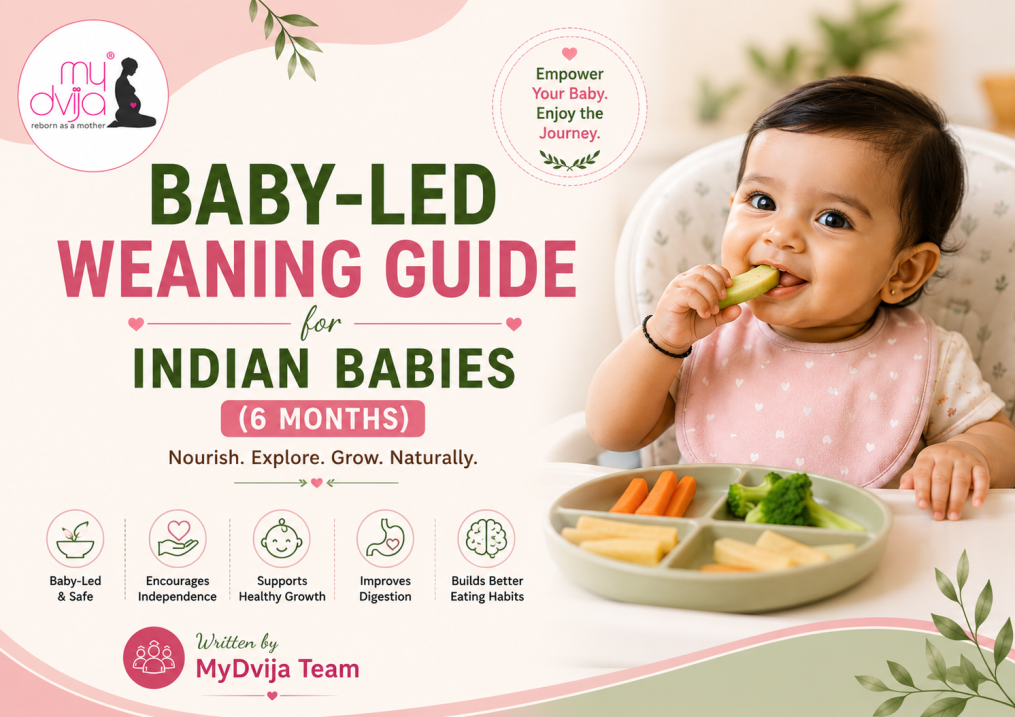
Start slow, one food at a time. Offer once a day alongside a milk feed, not instead of one — breast milk or formula is still the primary source of nutrition till 12 months. Cut food into stick shapes about the width of an adult finger, thicker than you’d expect, so baby can grip the top and gum the rest.
- Steamed sweet potato or lauki wedges.
- Ripe banana or papaya spears.
- Soft-cooked carrot sticks, steamed until they mash between two fingers.
- Roti strips dipped lightly in ghee.
- Idli fingers, plain or with a little ghee.
A soft porridge made from Mydvija Nachani Satva (Sprouted Ragi) works well here too — thick enough to offer on a pre-loaded spoon for babies who aren’t gripping food confidently yet, and it brings iron and calcium into the very first week of solids.
By the end of week 2, your baby will have met 5–6 single foods, learned to bring food to her own mouth, and you’ll know which textures she tolerates and which ones she isn’t ready for.
Weeks 3–8 — Building a Repertoire: –
Once baby is comfortable with single foods, start layering flavour and texture.
- Introduce dal-rice combinations and soft khichdi with visible, soft lumps.
- Add mild spices — jeera, haldi, a pinch of hing — in small amounts. Indian babies generally. handle this well; a reaction to flavour looks nothing like an allergic reaction.
- Introduce allergenic foods early and one at a time — egg, dairy, peanut (as a thin paste, never whole), fish — around 6–8 months, since early introduction may actually lower allergy risk. Discuss with your paediatrician first if there’s a family history.
- Rotate grains through the week — keep MyDvija Multigrain Mix and Oats Powder on hand so baby gets variety and fibre without you cooking five separate things every day.
By the end of week 8, your baby will be eating 2 meals a day, handling mixed textures, and you’ll have safely worked through the major allergen list.
Month 3 Onward — Eating as a Family: –
By around 9 months, your baby should mostly be sharing modified versions of what the rest of the family eats.
- Offer 3 meals plus snacks alongside milk feeds.
- Let baby sit at the table during family meals even on days she isn’t very hungry — it normalises eating together.
- Keep portions soft but slightly less mashed each week, moving gradually toward the textures you eat.
- On rushed mornings, MyDvija Ceramax (Instant Cereal Mix) makes a quick, nutritious breakfast base when there’s no time to cook from scratch.
Safety, Not Fear: –
Most of the anxiety around BLW comes from not knowing what to avoid and what’s actually fine.
- Avoid honey before 12 months, whole nuts, whole grapes and cherry tomatoes (always cut lengthwise), popcorn, and hard raw vegetable coins.
- Always supervise mealtimes — never leave baby alone with food, even for a minute.
- Learn infant CPR and the back-blow technique before you start — not because you’ll need it, but because knowing it removes the fear that makes BLW feel riskier than it is.
The Weaning Quick Reference: –
- Readiness: sits well, reaches for food, tongue-thrust reflex gone.
- Week 1–2: single soft foods, finger-shaped, once a day alongside milk.
- Weeks 3–8: mixed textures, mild spices, allergens introduced one at a time.
- Month 3+: family meals, 3 meals plus snacks, milk continues through the first year.
When Your Baby Refuses Food: –
This will happen, often more than once. It can take 10–15 exposures before a baby accepts a new food — that’s normal, not a sign you’re doing something wrong. Keep offering without pressure, keep mealtimes calm, and remember that milk is still covering most of her nutrition needs in these early months. A turned-away face today doesn’t mean that food is off the table for good.
If you’d rather be walked through this than figure it out from a blog post, MyDvija’s Weaning & BLW — Peaceful Way to Introduce Solids to Baby orientation covers exactly this stage, start to finish.
If your baby has reflux, a milk allergy, slow weight gain, or anything that makes you want a second opinion before you start, a 30-minute consultation with Shrreya Shah turns your specific situation into a personalised plan — not generic advice, yours.
You’ll also find free guidance in Hindi on weaning and first foods on the MyDvija YouTube channel.
Also Worth Reading
- Supplements for Newborn Babies — What Every Indian Parent Needs to Know
- Supplements for Toddlers — What Indian Children Actually Need
- Supplements for Kids (4–12 Years): What They Really Need
Six months. Two hundred grams of mashed sweet potato that ends up more on the floor than in her mouth. Three weeks of staring at a bowl of dal before she finally picks it up herself.
That’s the difference between a baby who is fed and a baby who learns to eat.
Your baby deserves to learn it her own way. So let her. Start today.