
Blog
Supplements for Teens (13–18 Years): What They Really Need

Supplements for Teens (13–18 Years): What They Really Need: –
My nephew started coaching this year — 6am wake-up, school, coaching till 8pm, then homework. Somewhere in there he started skipping breakfast and living on canteen samosas and a protein shake his gym-going friend recommended off an Instagram ad. My sister-in-law’s question to me wasn’t “is he eating enough” — it was “which supplement should I buy him.”
Wrong question, right instinct. Adolescence is the second-biggest growth window after infancy — bones, muscle, brain, and (for girls) a new monthly iron cost all landing at once, right when school schedules make food the first thing to get skipped. Supplements have a real place here. But food and sleep do the heavy lifting first.
The Numbers: –
- NFHS-5, India’s national health survey, found anaemia in ~59% of girls and ~31% of boys aged 15–19.
- The same multicentre study that screened younger children also followed 12–16-year-olds — calcium, vitamin D, and B12 deficiency stayed just as common through adolescence as in the 6–11 group.
- Anaemia is roughly twice as common in older teen girls (15–19) as in younger ones (10–14), driven largely by menstruation on top of an already tight diet.
This is the age where deficiencies stop being invisible — they show up as exhaustion during board exams, mood swings blamed on “teenage attitude,” and periods that are heavier or more painful than they should be.
Does Your Teen Even Need Supplements?
A teen eating three real meals, some fruit, and getting outdoors occasionally needs targeted support, not a shelf of pills. A teen running on canteen food, skipped breakfasts, and late-night study snacking is a different story. The honest starting point is the same as always: look at the week, not the ad.
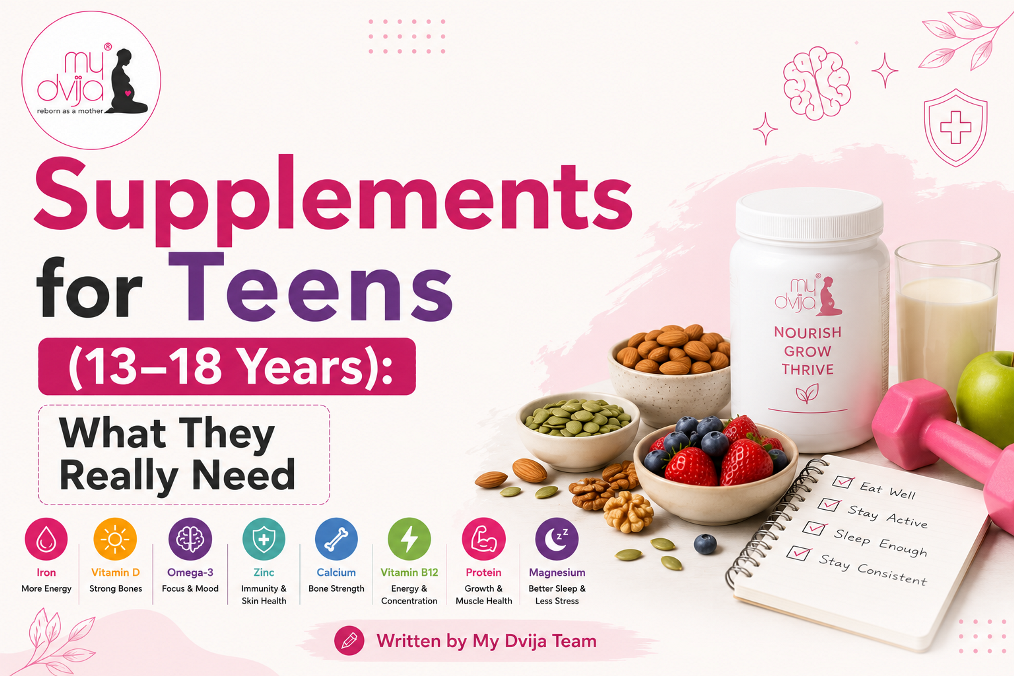
Iron — The One That Actually Matters Most Here
Every period is a monthly iron cost most teen girls’ diets don’t make up for. Add a growth spurt and coaching-class fatigue, and this becomes the single most common gap in this age group, in girls and boys both.
- Watch for: constant tiredness, pale inner eyelids/nails, breathlessness in PE, poor concentration during long study hours, hair fall.
- Higher risk: girls with heavy periods, vegetarian diets, or anyone skipping breakfast for extra study time.
- Fix: ragi (Nachani Satva) at breakfast, dal with lemon daily, Moringa Powder worked into parathas, Jaggery instead of sugar, Dates Syrup in evening milk.
A blood test (haemoglobin + ferritin) before supplementing — not a tonic bought because “she looks tired.” Unneeded iron isn’t harmless.
Calcium & Vitamin D — The Window Is Closing
Roughly 90% of adult bone mass is built by the end of the teenage years. This is the last real window to bank bone density — whatever isn’t built now is far harder to add later. And as always, vitamin D decides how much of that calcium actually gets absorbed.
- Watch for: frequent stress fractures or joint pain, poor posture, low energy during sport.
- Fix: milk, dahi, and til-based sweets daily; a spoon of Dvija Cow Ghee with meals to help absorb fat-soluble vitamin D; 20–30 min of actual daylight, most days — coaching-class schedules make this the easiest thing to lose.
- Supplement: 600–1000 IU vitamin D3 daily is reasonable for most Indian teens; confirm with a doctor if levels have been tested low.
Protein — Real Need, Heavily Oversold: –
Growth spurts genuinely raise protein needs, and teen boys chasing a gym physique aren’t wrong to think about it — they’re just getting sold the wrong version of it.
- Actual need: roughly 0.8–1 g of protein per kg body weight daily for most teens, a bit more for serious athletes — achievable through dal, paneer, eggs, milk, and dahi across the day, no powder required.
- The trap: Instagram-marketed protein powders sold to under-18s with little regard for dose or purity, often stacked with unnecessary “mass gainer” sugar and creatine blends.
- If a shake genuinely helps a picky eater hit protein targets: a plain whey isolate, checked with a doctor, in sensible amounts — not a pre-workout stack bought off an ad.
Vitamin B12 — Still the Vegetarian Blind Spot: –
Same story as at every earlier age: common in vegetarian households, invisible until it isn’t.
- Watch for: fatigue that doesn’t match sleep, poor concentration, low mood, tingling in hands/feet.
- Fix: dairy and eggs; strict vegetarian/vegan teens usually need a supplement — diet alone rarely closes this one.
Omega-3 — For Focus, Mood, and Skin: –
Long study hours, screen time, and the emotional weight of exam season all lean on the same nutrient most Indian diets under-supply.
- Fix: fatty fish 2–3x/week if eaten; otherwise, walnuts and Flax Seeds Powder daily in dahi or smoothies.
- Consider: an algae-based DHA supplement for vegetarian teens with genuinely low intake — ask a doctor for dosing.
Zinc — Growth, Acne, and Immunity: –
Zinc gets asked about mostly for one reason at this age: acne. It genuinely plays a role, alongside its usual jobs in growth and immunity.
- Fix: pumpkin seeds, til sweets, cashews/almonds, soaked dal — supplement only under medical guidance, since excess zinc blocks copper absorption.
Magnesium — The Exam-Season Nutrient Nobody Mentions: –
Magnesium supports sleep quality, muscle cramps (common with growth spurts), and the body’s stress response — all directly relevant during board exams and coaching-class burnout.
- Fix: nuts, seeds, whole grains, and dark leafy greens through the week — rarely needs a standalone supplement if the diet is reasonable.
Skip These — The Marketing Trap
- Unregulated protein/mass-gainer powders: marketed hard on social media to under-18s, often poorly dosed or adulterated.
- Energy drinks before exams: high caffeine and sugar, poor sleep the real cost the next day.
- “Detox” or weight-loss teas: no real evidence, and actively risky messaging for a body still growing.
- Acne supplements with unproven “herbal blends”: zinc and omega-3 have some evidence; most marketed acne stacks don’t.
- Pre-workout stacks: not appropriate for a still-developing teenage body regardless of what a gym trainer says.
The MyDvija Food-First Range: –
- Nachani Satva (Sprouted Ragi) — iron & calcium for a rushed pre-coaching-class breakfast.
- Moringa Powder — iron, calcium, vitamin C, easy to add to any meal.
- Multi Millet Noodles & Moringa Noodles — a whole-grain option that actually survives a long study day.
- Jaggery Powder & Dates Syrup — iron-rich sugar replacements.
- Cow Ghee (Vedic Style) — helps absorb fat-soluble vitamins already in the meal.
- Flax Seeds Powder — daily omega-3, stirred in unnoticed.
A Simple Daily Rhythm
- Morning: ragi dosa/porridge with ghee, a glass of milk — non-negotiable even on exam days.
- Lunch/tiffin: dal, roti, a vegetable, and paneer or egg — protein at every main meal, not just one.
- Study-break snack: nuts, seeds, or roasted chana instead of packaged chips or biscuits.
- Dinner: dal with lemon, a vegetable, a small portion of non-veg or paneer.
- Before bed: warm milk with a teaspoon of Dates Syrup — and a real wind-down from screens, for both sleep and stress.
Talk to a Doctor If…
- Periods are very heavy, painful, or irregular — worth ruling out iron deficiency and, longer term, PCOS.
- Persistent fatigue doesn’t improve with more sleep.
- Growth or weight seems off track for their age.
- A strict vegetarian/vegan diet with no B12 source.
- Any interest in protein powders or gym supplements — get a dose and product checked before your teen buys it themselves.
For a plan tailored to your teen — book a consultation with Shrreya Shah, or follow practical guidance on the MyDvija YouTube channel.
Also Worth Reading
- Supplements for Kids (4–12 Years) — What They Really Need
- PCOS — Symptoms, Causes, and What Women Need to Know
- Iron Deficiency in Women: Signs You’re Ignoring
My nephew’s coching year is still brutal — that part doesn’t change. But breakfast is non-negotiable now, the protein shake got swapped for eggs and dal at meals, and a blood test showed his iron actually was low, so that got fixed properly instead of guessed at.
Feed the growth spurt before you feed the marketing.