
Blog
PCOS Symptoms and Causes: What Every Woman Needs to Know

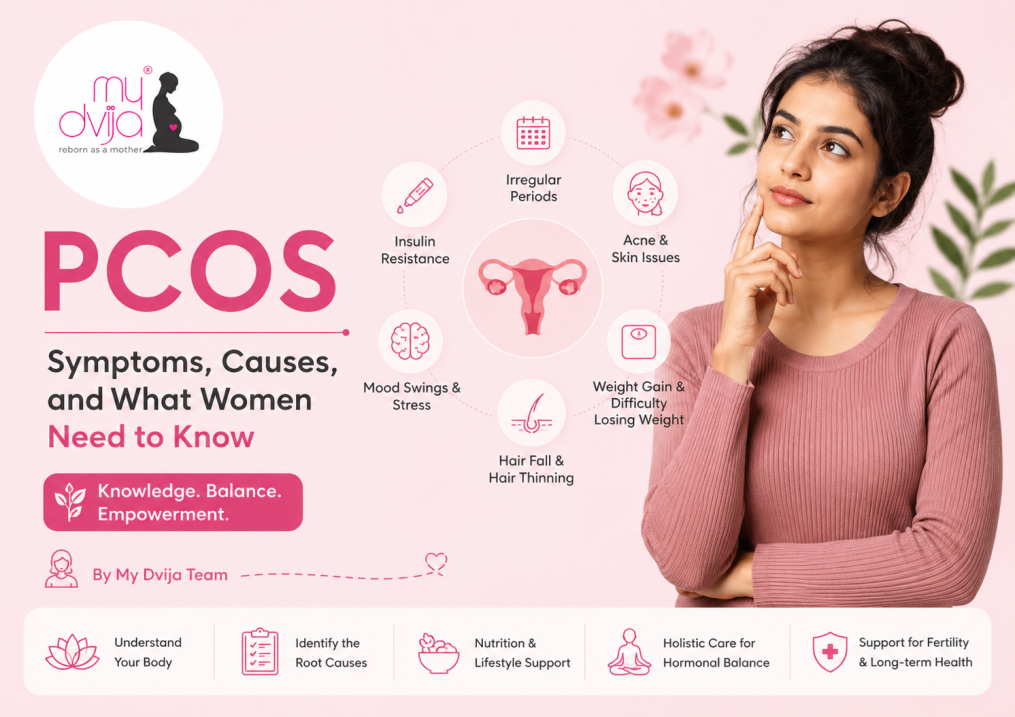
PCOS — Symptoms, Causes, and What Women Need to Know
You’ve been told your periods are “just irregular.” Or that your weight gain is something you simply need to manage better. Or that the acne and the hair on your chin and the fact that you’re exhausted all the time are just — normal things that happen to women.
They are not.
PCOS — Polycystic Ovarian Syndrome — is one of the most common hormonal conditions affecting women of reproductive age. It is also one of the most misunderstood, misdiagnosed, and dismissed.
If you’ve been living with unexplained symptoms and not getting real answers, this is for you.
Before we dive in — if you’d rather watch than read, check out our My Dvija on YouTube where Shrreya Shah explains women’s health and hormonal conditions in plain language, without the overwhelm.
First — What Is PCOS, Actually?
PCOS is a hormonal imbalance in which the ovaries produce higher-than-normal levels of androgens (male hormones). This disrupts the normal process of ovulation — the monthly release of an egg — and can cause small fluid-filled sacs (follicles) to build up in the ovaries instead.
It is not a disease you either have or don’t have. It’s a spectrum, and it looks different in different women.
What makes PCOS complicated is this: you don’t need all the symptoms to have it. You don’t even need cysts on your ovaries. The name is actually a bit misleading.
Doctors typically diagnose PCOS using the Rotterdam Criteria — meaning you need at least two of the following three things:
- Irregular or absent periods
- Elevated androgen levels (shown in blood tests or visible symptoms like excess hair, acne)
- Polycystic ovaries on an ultrasound
Two out of three. That’s it. Which means there are women with PCOS who have regular periods. There are women who have polycystic ovaries and no other symptoms. The condition is deeply individual.
The Symptoms — And Why They’re So Easy to Miss
PCOS doesn’t announce itself with one clear, unmistakable sign. It tends to creep in through a cluster of things that are easy to write off — or blame on something else entirely.
1. Irregular Periods
This is often the first thing women notice — or the thing they’ve spent years normalizing. Cycles that are longer than 35 days, fewer than 8 periods a year, skipped months, or periods that come unpredictably.
For some women, this started in their teens. Many were put on birth control pills as a solution — which masks the problem without addressing the hormonal imbalance underneath.
2. Excess Hair Growth: –
Hair on the chin, upper lip, chest, stomach, or inner thighs — in a pattern more typical of male hair growth. This is caused by elevated androgens, and for many women in India, it becomes a source of deep shame and constant effort to manage.
It’s not a beauty problem. It’s a hormonal symptom.
3. Acne — Especially on the Jawline and Chin: –
Hormonal acne that doesn’t respond to topical treatments, that flares cyclically, that shows up deep and painful along the jawline. A lot of women with PCOS have been going to dermatologists for years without anyone connecting the dots.
4. Hair Thinning or Hair Loss: –
The same androgens causing excess facial hair can cause the hair on your scalp to thin. Thinning at the crown or temples, increased shedding, a widening parting — these are all possible signs.
5. Weight Gain — Particularly Around the Abdomen: –
Many women with PCOS describe doing everything “right” and still gaining weight, or finding it impossible to lose. This isn’t a willpower problem. PCOS is closely linked to insulin resistance — a state where your body doesn’t respond efficiently to insulin — which makes fat storage easier and fat loss harder.
Not all women with PCOS are overweight. This is another reason it gets missed — the “lean PCOS” presentation is real and valid.
6. Fatigue: –
A deep, persistent tiredness that doesn’t resolve with sleep. Brain fog. Difficulty concentrating. This is often linked to blood sugar fluctuations from insulin resistance, or simply the toll of living with an unmanaged hormonal condition.
7. Mood Changes: –
Anxiety and depression are significantly more common in women with PCOS. Hormonal imbalances affect neurotransmitters. The emotional symptoms are real — and they’re physiological, not a personal failing.
8. Difficulty Getting Pregnant: –
Because PCOS disrupts ovulation, it is one of the leading causes of female infertility. This doesn’t mean women with PCOS can’t conceive — many do, with or without intervention. But it does mean the irregular ovulation makes timing difficult and fertility support is often needed.
What Causes PCOS?
Here is the honest answer: we don’t fully know.
What research does show is that PCOS is likely caused by a combination of factors:
- Genetics: PCOS runs in families. If your mother, sister, or aunt has it, your risk is higher.
- Insulin resistance: Around 70% of women with PCOS have some degree of insulin resistance. When cells don’t respond well to insulin, the pancreas produces more of it — and excess insulin signals the ovaries to produce more androgens.
- Inflammation: Low-grade chronic inflammation is commonly found in women with PCOS and may stimulate the ovaries to produce excess androgens.
- Hormonal feedback loops: The hypothalamus and pituitary gland — which regulate hormone signals — behave differently in women with PCOS, leading to elevated LH levels and disrupted follicle development.
What does not cause PCOS: your diet alone, your stress levels alone, your body weight alone. These factors can influence how PCOS expresses itself, but they are not the root cause.
The Indian Family Layer
Can we be honest about what it’s like to have PCOS in an Indian family?
You’re told the facial hair is embarrassing. You’re told you need to lose weight before you get married. You’re told your irregular periods will sort themselves out once you have a baby. You’re given besan ubtan for your skin and told to eat less.
Nobody says: your hormones are dysregulated, and there is support available.
PCOS in India is vastly underdiagnosed — not because it’s rarer here, but because the symptoms get normalised, moralised, or cosmetically managed rather than medically addressed. Women go years without a diagnosis. Many are diagnosed only when they’re trying to conceive.
If you’ve been dismissed or told this is “just how your body is” — you deserve better than that.
A note on Ayurvedic support:
Alongside medical treatment, many women find value in herbs that support hormonal balance. Dvija Natural Shatavari Powder is an Ayurvedic supplement with a long history of use for women’s hormonal health — it supports the hypothalamic-pituitary-ovarian axis, helps regulate the menstrual cycle, and supports the endocrine system broadly. It’s recommended from the 5th month of pregnancy through postpartum, and many women with PCOS use it as part of a longer-term hormonal support routine.
It is not a replacement for medical diagnosis or treatment. But it’s a gentle, traditionally grounded complement to whatever else you’re doing.
Getting Diagnosed — What to Expect
There is no single definitive test for PCOS. Diagnosis usually involves:
- Detailed history: Your cycle, symptoms, family history
- Blood tests: LH, FSH, testosterone, DHEA-S, insulin, fasting glucose, thyroid panel (to rule out other causes)
- Pelvic ultrasound: To look at the ovaries and endometrial lining
Go in informed. Ask specifically about androgens and insulin resistance if your doctor doesn’t bring them up. If you feel dismissed, seek a second opinion. A good gynaecologist or endocrinologist who takes PCOS seriously will look at the full picture.
Managing PCOS — What Actually Helps
There is no cure for PCOS. But it is highly manageable — and with the right approach, most women see significant improvement in their symptoms.
Lifestyle First — And Not as a Punishment
Because insulin resistance underlies so much of PCOS, the interventions that improve insulin sensitivity make a meaningful difference:
- Movement: Strength training and walking are particularly helpful. You don’t need intense cardio. Consistency matters more than intensity.
- Diet: Reducing refined carbohydrates and added sugars, eating balanced meals with protein and healthy fats, not skipping meals. Not a crash diet. A sustainable pattern.
- Sleep: Poor sleep worsens insulin resistance and hormone dysregulation. This is not optional.
- Stress management: Chronic stress raises cortisol, which interacts with insulin and androgens. This is physiological — not just self-care advice.
If you need structured support with movement and nutrition — and not the generic kind:
- 100 Days Weight Loss Programme — MyDvija — A holistic 100-day programme with guided workouts (yoga, strength training, dance), personalized meal plans, live doctor & nutritionist appointments, and weekly meditation. Designed for women’s bodies, not generic fitness advice.
- Nutrition & Diet for New Mothers — MyDvija — An online recorded course covering the right foods, proportions, and nutritional balance to support your body’s recovery and hormonal health. Especially relevant if you’re postpartum with PCOS.
- Strength Exercises — MyDvija — Pre-recorded strength workouts you can do at your own pace. Resistance training is one of the most evidence-backed interventions for insulin resistance.
When to Actually Seek Help
See a doctor if:
- Your periods are consistently irregular — fewer than 8 a year, or gaps of more than 35 days
- You have noticeable, increasing facial or body hair
- You’re experiencing hair loss on your scalp
- You’ve been struggling with unexplained weight gain despite reasonable effort
- You’ve been trying to conceive for 6–12 months without success
- You have persistent acne that doesn’t respond to topical treatment
- You feel constantly fatigued or are experiencing significant mood changes
Any one of these is reason enough. You don’t need to have all of them.
Book a 30-minute consultation with Shrreya Shah if you want support in understanding your symptoms, navigating your diagnosis, or figuring out where to start. She understands the Indian context — the family dynamics, the stigma, the way these conversations actually happen — and gives guidance that works in real life.
Not sure if you need a full consultation? Start with a free 5-minute enquiry call with the MyDvija team first.
What You Can Stop Worrying About
PCOS does not mean you cannot have children. Many women with PCOS conceive naturally. Many others conceive with support. It is a fertility challenge, not a verdict.
PCOS does not mean you caused this. It is not a consequence of your diet, your weight, your choices. It is a condition with genetic and physiological roots.
PCOS does not mean you have to live with the symptoms. This is not something you just endure. Management works.
Read More on MyDvija
If this helped, these are worth reading next:
- → 100 Days Weight Loss Programme — MyDvija — Guided workouts, personalized meal plans, and hormonal health support in one structured programme.
- → Nutrition & Diet Course — MyDvija — Learn how to eat in a way that supports hormonal balance, energy, and recovery.
- → Strength Exercises Course — MyDvija — Pre-recorded resistance training workouts that directly support insulin sensitivity.
- → Essential Supplements for Mothers — Pregnancy, Breastfeeding & Postpartum — What your body actually needs at every stage.
- → All Women’s Health Articles on MyDvija — Browse the full archive.
Real Talk
PCOS is one of those conditions that women are expected to quietly manage — the extra hair removal, the acne cover-up, the diets, the period apps — without ever being given the full picture of what is actually happening in their bodies.
You deserve the full picture.
You deserve a doctor who takes your symptoms seriously. You deserve to understand your own hormones. You deserve to know that what you’re experiencing has a name, a mechanism, and options.
This is not just how your body is. It’s how your body is responding to a hormonal imbalance that can be understood and addressed.
Be easy on yourself. You’re doing your best with information you’re only just getting.
Need More Help?
Follow My Dvija on YouTube for free videos on hormonal health, fertility, breastfeeding, and women’s wellness — explained plainly and honestly.
Or visit mydvija.com for courses, consultations, and products designed for where you actually are right now.
You’re not alone in this. And it gets better with the right support.