
Blog
How to Get Pregnant Naturally — Guide for Indian Couples


How to Get Pregnant Naturally — Guide for Indian Couples: –
We decided we wanted a baby on a Sunday afternoon. By the following Sunday, I’d read forty articles, downloaded three apps, and convinced myself something was wrong with us before we’d even tried once. My husband, sensibly, had done none of this and was considerably calmer than I was.
What I wish someone had told me then: conception is a process, not a test. Here’s everything that actually matters — what to do, when to do it, and what gets in the way.
The Real Timeline: –
Start with the odds, because they change everything about how this feels. In your mid-to-late 20s, you have roughly a 25–30% chance of conceiving in any given cycle — the best odds of any age group. By 30–35, that drops to about 15–20% per cycle. “Infertility,” medically, means 12 months of trying without success — or 6 if you’re over 35. Not month one. Not month three.
So if you’re not pregnant yet, you’re very likely in the normal range, not a problem case. And the pressure to conceive immediately — which Indian family dynamics often amplify — works against you: stress raises cortisol, and cortisol directly suppresses the hormones that drive ovulation. The anxiety isn’t just uncomfortable. It’s counterproductive.
Your Fertile Window: –
This is the single most practical thing you can get right. You can have perfect nutrition and perfect supplements, but if you’re not timing intercourse correctly, none of it matters. The egg survives only 12–24 hours after release; sperm can survive up to 5 days. That gives you a fertile window of about 6 days — the 5 days before ovulation, plus the day itself.
The most reliable way to find that window is an ovulation predictor kit (OPK), which tests for the LH surge 24–36 hours before ovulation — start testing from day 10 of your cycle. Cervical mucus is a useful second signal: around ovulation it turns clear and stretchy, often described as resembling raw egg white. Basal body temperature confirms ovulation happened but won’t predict it in advance, and period-tracking apps alone are unreliable, especially with irregular cycles — use them alongside an OPK, not instead of one.
And don’t aim for a single perfect day. Intercourse every 1–2 days through the fertile window works better than trying to hit one exact target — and it takes the pressure off.
The 3-Month Prep — For Her: –
Three months isn’t an arbitrary number — it’s roughly how long it takes an egg to complete its development cycle. Whatever your body experiences nutritionally in these three months shapes the quality of what releases later.
Start folic acid (400 mcg daily) now, not after a positive test — the neural tube closes at 28 days post-conception, often before you even know you’re pregnant. Iron deficiency shows up in more than half of Indian women planning pregnancy, so get a ferritin test and lean on ragi (Nachani Satva), dal, Moringa Powder, and Jaggery instead of sugar. Vitamin D deficiency is close to universal in urban India — 70–90% of women test low — so get tested, and pair 1000–2000 IU of D3 with 15 minutes of morning sun.
One more worth starting early: Dvija Natural Shatavari, half a teaspoon in warm milk daily. A 2025 clinical trial found it improved FSH-LH ratios and ovarian function — it’s a tonic, not a quick fix, so give it the full three months before trying.
The 3-Month Prep — For Him: –
Sperm takes about 74 days to develop, so whatever changes now will show up in the sample that matters. Zinc and selenium support sperm development directly — pumpkin seeds, sesame, eggs, and whole grains cover both. Oxidative stress is the leading cause of poor sperm quality, so antioxidant-rich foods help: amla, guava, citrus for vitamin C, nuts and seeds for vitamin E, cooked tomato for lycopene.
A few things to dial back: laptops resting directly on the lap, long hot baths, and tight underwear all raise scrotal temperature above what’s ideal for sperm production. Alcohol reduces testosterone and impairs motility even in moderate amounts. And ashwagandha is worth considering — a 2024 randomised controlled trial found it improved sperm count, motility, and morphology, while also lowering cortisol.
Blood Tests to Get First: –
Several conditions affect fertility significantly and are entirely treatable once caught — but invisible without testing. Before you start trying, it’s worth getting:
- Thyroid panel (TSH, Free T3, Free T4): even mild elevation affects ovulation and miscarriage risk..
- Ferritin: below 30 affects fertility even when haemoglobin looks normal.
- Vitamin D (25-OH): to calibrate your supplement dose.
- AMH: the most stable marker of ovarian reserve, especially useful over 30.
- Fasting blood sugar & HbA1c, and rubella immunity.
Blood results are only useful once you know what to do with them — a 30-minute consultation with Shrreya Shah turns yours into a specific, personal plan.
Eat This Way: –
Fertility nutrition research keeps landing on the same pattern: whole foods, enough protein, healthy fats, low refined carbs, high antioxidants. For an Indian kitchen, that looks like dal at every main meal, a daily bowl of sprouted ragi, and full-fat dairy — the Harvard Nurses’ Health Study specifically found full-fat, not low-fat, dairy associated with better ovulatory fertility. Add a spoon of ghee to every main meal for hormone-supporting fat, leafy greens for folate and iron, and a daily tablespoon of Flax Seeds Powder for omega-3s. A little Dates Syrup in warm milk covers iron and B vitamins in a form that’s easy to keep up daily.
What to pull back on: refined sugar and flour, trans fats (vanaspati, most packaged snacks — directly linked to ovulatory infertility in research), alcohol, more than 200mg of caffeine a day (about two coffees), and heavily processed food generally.
Move Right: –
Exercise helps fertility, but the type matters. Thirty minutes of moderate cardio five days a week improves insulin sensitivity and lowers cortisol. Strength training two to three times a week does the same, and is especially useful if you have PCOS or insulin resistance. Gentle, restorative yoga — poses like legs-up-the-wall or butterfly pose — has real evidence for improving blood flow to the reproductive organs and shifting the body into a rest-and-digest state that’s conducive to conception.
The one thing to actually avoid is the opposite extreme — marathon training or daily intense HIIT can suppress ovulation by dropping body fat too low and keeping cortisol chronically elevated. If you’d rather have this structured for you than figure it out alone, MyDvija’s Personal Fitness Training programme is built specifically for couples preparing to conceive.
Manage the Stress: –
This isn’t a soft, add-on suggestion. Cortisol directly suppresses the hormonal axis that drives ovulation, and studies of women undergoing IVF found that those with the highest cortisol levels had measurably lower pregnancy rates — with identical protocols. The Indian trying-to-conceive experience adds its own specific weight to this: the “when are you having a baby” questions, the shift from sex as intimacy to sex as a scheduled task, the two-week wait after ovulation, the quiet grief of each negative test.
What actually helps: five to ten minutes of pranayama daily — anulom-vilom measurably lowers cortisol within a single session, and recalibrates your baseline over a few months of practice. MyDvija’s 9 Months – 9 Connections meditation series is designed to pick up right where this leaves off, once you conceive. And perhaps most simply: couples who talk openly about the emotional weight of trying — not just the tracking and timing — consistently do better than those who carry it silently.
The PCOS & Thyroid Check: –
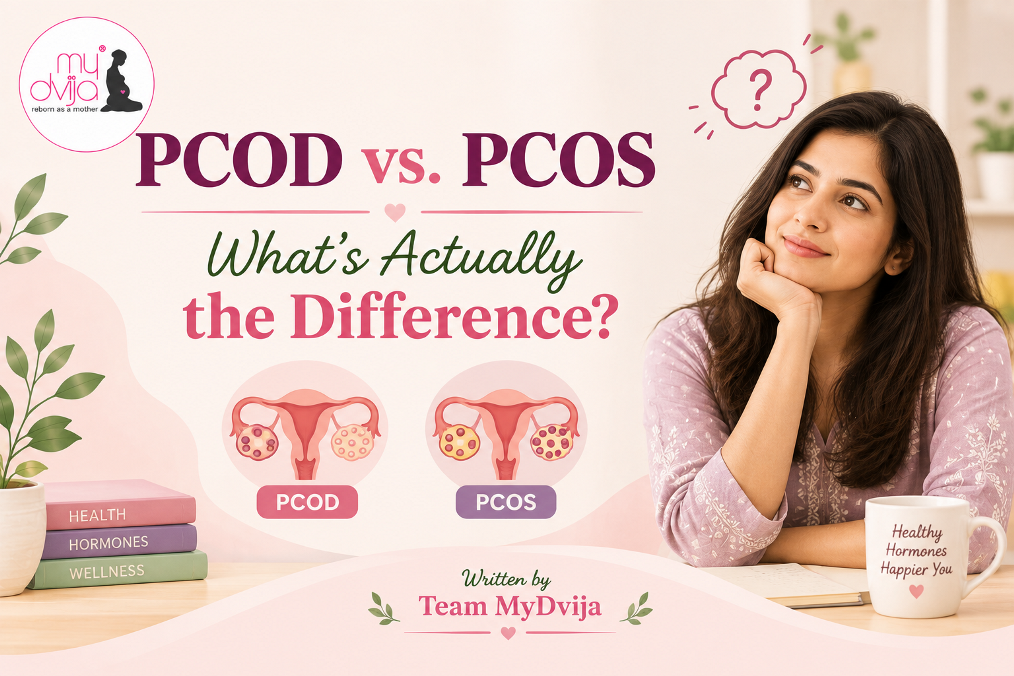
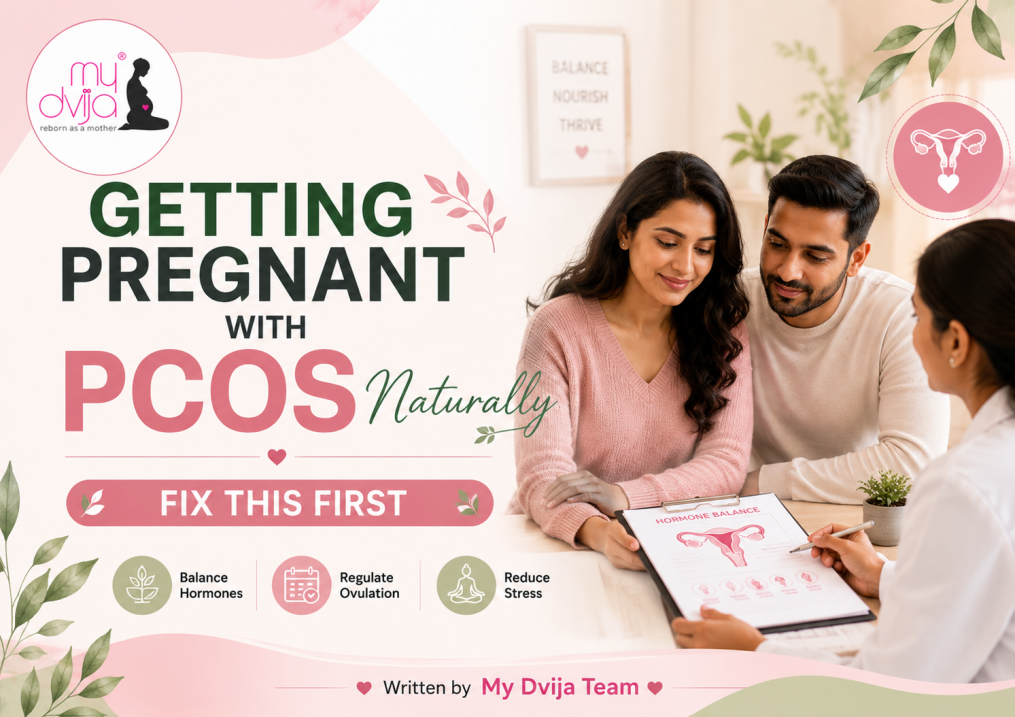
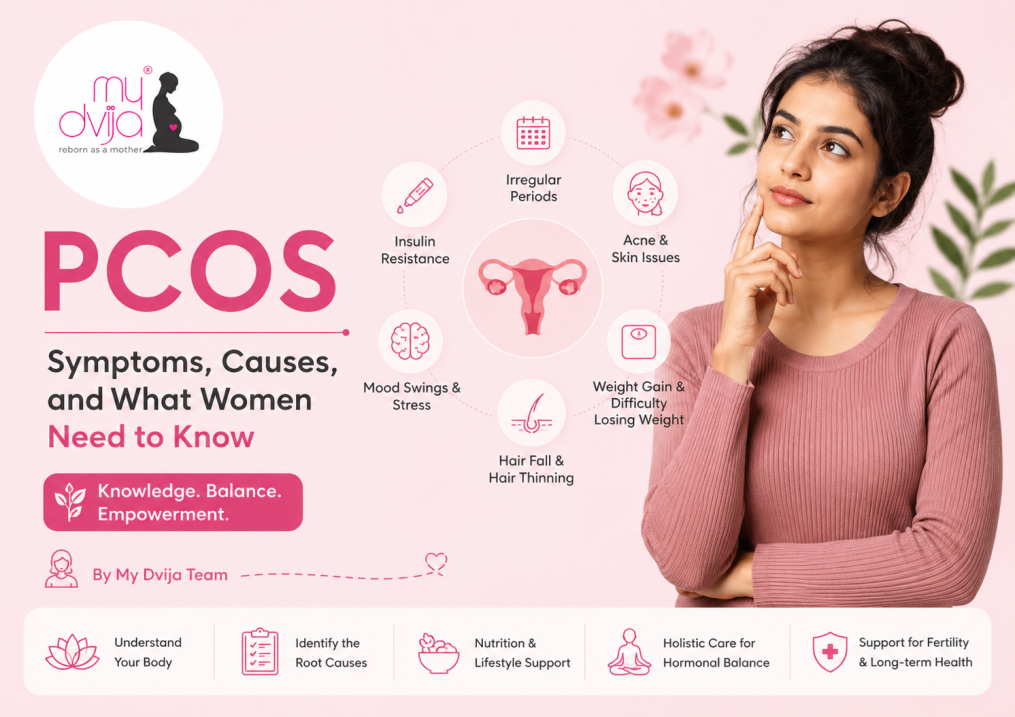
Two conditions quietly account for a large share of difficulty conceiving in Indian women. PCOS affects roughly 1 in 5, and is the leading cause of anovulatory infertility — but it responds unusually well to lifestyle change; correcting insulin resistance through diet and exercise restores regular ovulation in many women without any medical intervention. Thyroid dysfunction, particularly subclinical hypothyroidism, is just as common and far less talked about — even mildly elevated TSH affects ovulation, implantation, and early pregnancy. Getting both checked before you start trying is one of the highest-leverage things you can do.
When to See a Doctor: –
If you’ve been timing intercourse correctly and it still hasn’t happened, here’s when to stop waiting: 12 months of trying if you’re under 35 with regular cycles, 6 months if you’re over 35, and immediately if you have known PCOS, thyroid disease, irregular periods, or a history of pelvic surgery.
One thing worth saying plainly: semen analysis is often delayed because of stigma, but male factors account for roughly 40–50% of all infertility. Both partners should be evaluated together, not one after the other.
Get 1:1 Support: –
Everything above will take most couples a long way on its own. But if you’d rather have a real person guiding the specifics — your body, your cycle, your blood work — MyDvija offers a few ways in: Personal Fitness Training for a preconception-focused movement plan led by Shrreya Shah, a 1:1 Nutritionist Consultation for a personalised read of your diet and test results, and the 100 Days Weight Loss & Fitness Programme if you want structured workouts, live nutritionist access, and weekly meditation built into one plan for your prep window.
Also Worth Reading: –
- Folic Acid Before Pregnancy — The Complete Indian Guide
- PCOS — Symptoms, Causes and What Every Woman Needs to Know
- What Is Garbhasanskar & Why Every Expecting Parent Should Know It
The body already knows how to do this. Your job in these months is just to give it the conditions to do it well — the nutrition, the rest, the timing, and the readiness. Your baby’s story is already beginning. This is its first chapter.