
Blog
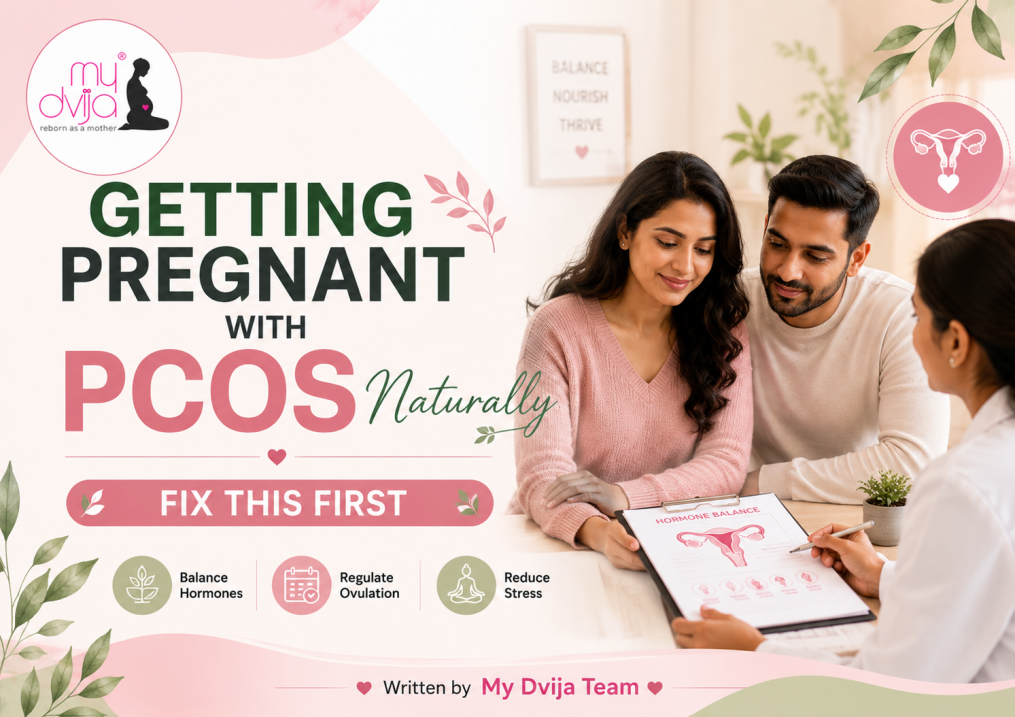
Getting Pregnant With PCOS Naturally — Fix This First

Getting Pregnant With PCOS — Fix This First, Then Try
She had been trying for eight months.
Her cycles were everywhere. One month 24 days, the next 47. Some months, nothing. Her doctor told her to lose some weight and see what happens.
Nobody told her that PCOS — the condition causing all of this — is the most treatable cause of ovulatory infertility there is. And that the treatment often doesn’t begin with medication. It begins with understanding what PCOS actually does to your body, and then fixing that.
What PCOS Actually Does to Fertility: –
1 in 5 Indian women has PCOS. It is the single most common cause of anovulatory infertility — infertility caused by missing or irregular ovulation. But here is what most women with PCOS are never clearly told: PCOS does not mean you cannot get pregnant. It means ovulation is irregular. And irregular ovulation can be improved — often significantly — through the right changes before you ever try.
The key is understanding what is actually driving the irregularity. Because PCOS is not one thing. It is a hormonal pattern with a specific root cause — and when you fix the root, ovulation often follows.
The Root Cause Most Doctors Don’t Explain :-
In the majority of PCOS cases, the main driver is insulin resistance.
When cells stop responding properly to insulin, the body produces more and more of it to compensate. High insulin then signals the ovaries to make excess androgens — testosterone-like hormones. Those androgens disrupt ovulation. Disrupted ovulation means irregular periods and difficulty conceiving.
That is the chain. And you can interrupt it.
What drives insulin resistance and worsens PCOS: refined carbohydrates like maida and excess white rice, packaged biscuits, sugar in everything, sitting for most of the day, chronic poor sleep, and chronic stress. The Indian urban lifestyle, for many women, hits all four. Which is why PCOS is so widespread — and why it responds so well when these are addressed.
Fix Insulin First :-
This is the highest-leverage step for PCOS fertility. Everything else builds on it.
1. Change what you eat — in this order: –
Start with protein at every meal. Dal, paneer, eggs, dahi at breakfast, lunch, and dinner. Protein slows glucose absorption and reduces the insulin spikes that worsen PCOS. Replace all refined sugar with MyDvija’s Natural Jaggery Powder — lower glycaemic, adds iron, and doesn’t spike insulin the way refined sugar does. Cut back on refined flour: switch maida rotis to jowar, bajra, or ragi. And add Nachani Satva (Sprouted Ragi) for breakfast every day — it digests slowly, keeps insulin steady, and gives you iron and calcium your PCOS-affected body often runs low on.
2. Walk after meals: –
A 10-minute walk after lunch and dinner reduces post-meal blood glucose by 30–40%. That is a measurable drop in the insulin spike that worsens PCOS. You don’t need a gym. You need 10 minutes, twice a day.
3. Add strength training: –
Muscle tissue is where insulin-driven glucose uptake happens. The more muscle you build, the better insulin works — and the less androgen your ovaries produce. Two to three sessions a week of bodyweight squats, lunges, and resistance work. No equipment needed.
Shatavari — The Herb That Works on PCOS at the Root :-
Shatavari has been used in Ayurveda for female reproductive health for centuries. In 2025, a placebo-controlled clinical trial confirmed what Ayurvedic practitioners had long observed.
The trial found that shatavari improved FSH and LH ratios — the hormones that signal ovulation. It increased SHBG, which binds free testosterone and reduces its effect on the ovaries. It improved insulin sensitivity markers, directly addressing the root driver of PCOS. And it reduced androgen-driven symptoms including acne, excess hair, and cycle irregularity.
Shatavari is not a drug. It is an adaptogen — it works with your body’s hormonal system rather than overriding it. Take ½ teaspoon of Dvija Natural Shatavari in warm milk every night, with a pinch of black pepper and a small piece of ghee. Give it three months minimum before evaluating. Adaptogens work on hormonal rhythms — not in one week.
Support Hormonal Balance Through What You Eat :-
Beyond insulin, PCOS involves excess androgens and often poor oestrogen metabolism. The right daily foods address both.
Add 1 teaspoon of MyDvija’s Moringa Powder to dal or warm water every morning. It is anti-inflammatory, rich in iron, calcium, magnesium, and vitamin C. PCOS drives chronic low-grade inflammation that worsens androgen production — moringa’s anti-inflammatory profile works against this directly.
Keep ghee in every main meal. Oestrogen and progesterone are synthesised from cholesterol — a very low-fat diet impairs hormone production. One teaspoon of Dvija Cow Ghee at lunch and dinner provides fat-soluble vitamins, butyrate for gut health, and the healthy fat your hormones need.
Add Dvija Dates Syrup to warm milk daily. Women with PCOS often have heavy periods when they do occur, causing significant iron loss. Dates provide iron and B vitamins in a naturally sweet form that doesn’t spike blood sugar.
And take ½ tablespoon of Flax Seeds Powder in dahi every day. Lignans in flaxseeds support oestrogen metabolism and help reduce the androgen excess that blocks ovulation.
Track Ovulation Differently With PCOS :-
With PCOS, cycle tracking apps are unreliable. Your cycle length changes month to month. Day-14 ovulation estimates don’t apply — you might ovulate on day 19 one month and day 34 the next, or not at all.
Use Ovulation Predictor Kits (OPKs) every cycle instead. Begin testing from day 10 and continue until you get a positive LH surge, even if that means testing until day 25 or 30. A positive result means ovulation in 24–36 hours — plan intercourse on the day of the positive and the day after. Two or three months of OPK tracking tells you whether ovulation is happening and when. That information is far more useful than any app’s prediction.
Manage Stress — Seriously :-
This is the step most PCOS fertility advice saves for last, or leaves out entirely. It shouldn’t be.
Cortisol raises insulin. Insulin raises androgens. Androgens block ovulation. For women with PCOS, stress doesn’t just make conception emotionally harder — it makes it physiologically harder. Every cortisol spike worsens the hormonal problem you are already trying to fix.
Add 5 minutes of anulom-vilom pranayama every morning. It measurably lowers cortisol within a single session through vagus nerve activation. Over 90 days of consistent practice, it recalibrates your resting hormonal baseline.
Build a sleep routine that protects 7–8 hours. Even two weeks of 5-hour nights measurably raises insulin resistance in women. Sleep is not optional for PCOS management.
And begin a meditation practice before you start trying — not after a positive test. MyDvija’s 9 Months – 9 Connections: Guided Pregnancy Meditation & Garbhasanskar Series is a recorded series of 9 guided meditation and Garbhasanskar sessions — one per month of pregnancy — covering breathwork, visualisation, and womb connection practices. Starting it in the preconception period means that when conception happens, the practice is already running. You enter pregnancy calm, not scrambling to find something that helps.
What to Realistically Expect :-
In months one and two, your cycles may still be irregular. You are changing a hormonal environment, not flicking a switch. That is normal. Many women notice their cycle length becoming more consistent in months two and three — and skin improvements are often the first visible sign that androgens are coming down.
By months three to six, ovulation becomes more predictable for many women. OPKs begin detecting a positive more reliably. The research on PCOS and lifestyle change consistently shows that women who implement these kinds of changes see significant improvement in ovulation frequency within three to six months.
This takes patience. It is also significantly faster than staying on the same path and expecting a different result.
When to Add Medical Support :-
Lifestyle changes are powerful. They are not always sufficient on their own. See a gynaecologist if you have been making these changes consistently for six months without improvement in cycle regularity, if your AMH is very low, if you are over 35 and have been trying for more than three months, or if your partner has known fertility issues.
First-line medical options for PCOS fertility — typically letrozole or clomiphene — work very well alongside the lifestyle foundation described here. They work much less effectively without it.
If you are unsure where to start, or if your blood results showed something concerning, a 30-minute consultation with Shrreya Shah turns your specific PCOS picture into a personalised plan. Not a generic PCOS diet from the internet — yours, based on your results, your cycle, and your health history.
You’ll also find free guidance on PCOS, fertility, and hormonal health in Hindi on the MyDvija YouTube channel.
Also Worth Reading :-
- PCOS — Symptoms, Causes and What Every Woman Needs to Know
- How to Get Pregnant Naturally — The Complete Guide for Indian Couples
- The 90-Day Preconception Plan
- Shatavari for Fertility — What the 2025 Research Shows
- How to Balance Hormones Naturally
The woman who had been trying for eight months? She conceived in month five of making these changes.
Not because she did something miraculous. Because she finally understood what was actually happening in her body — and addressed that.
That information was always available. It just wasn’t being given to her.
Now it’s yours. Start today.